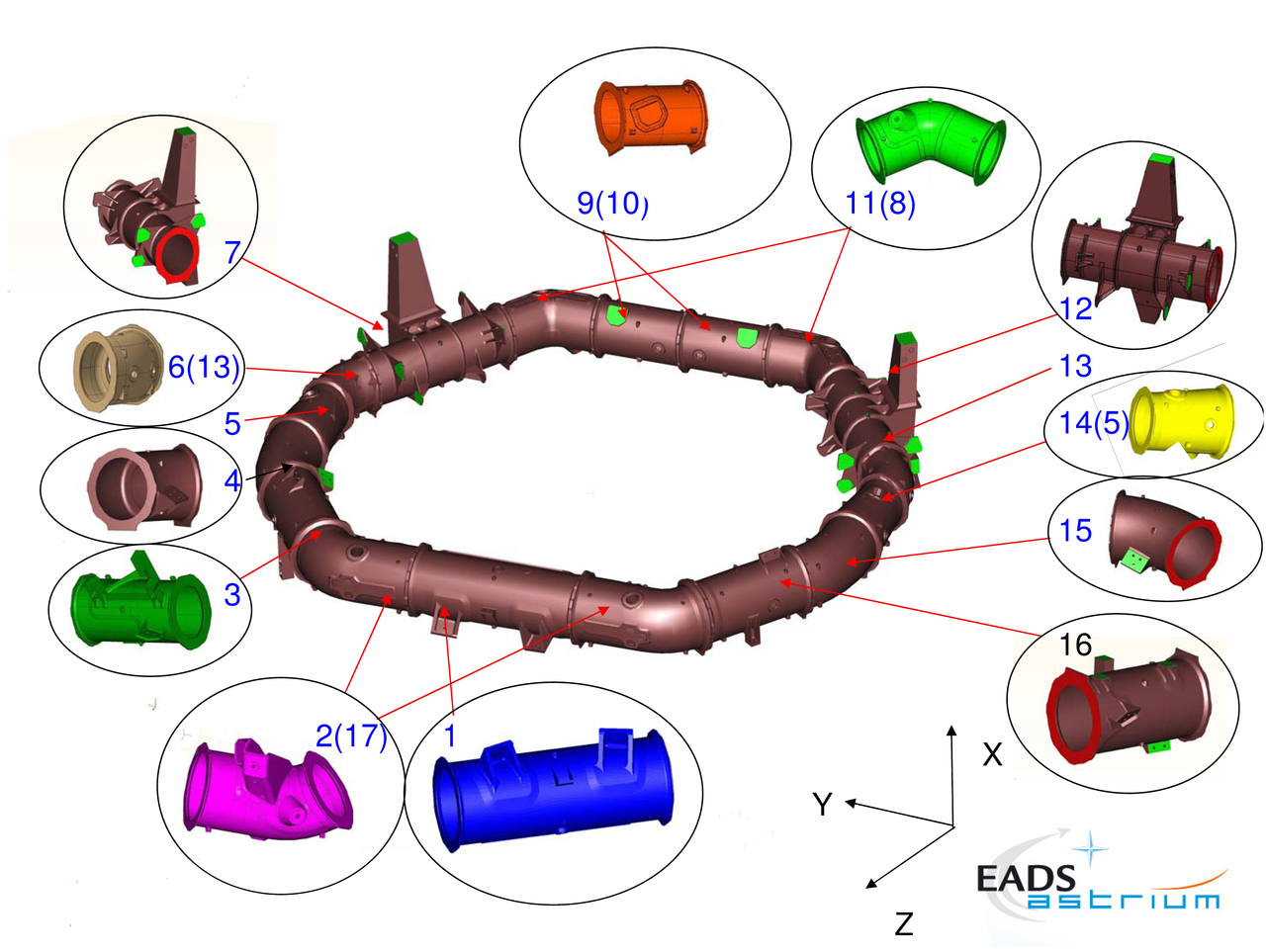
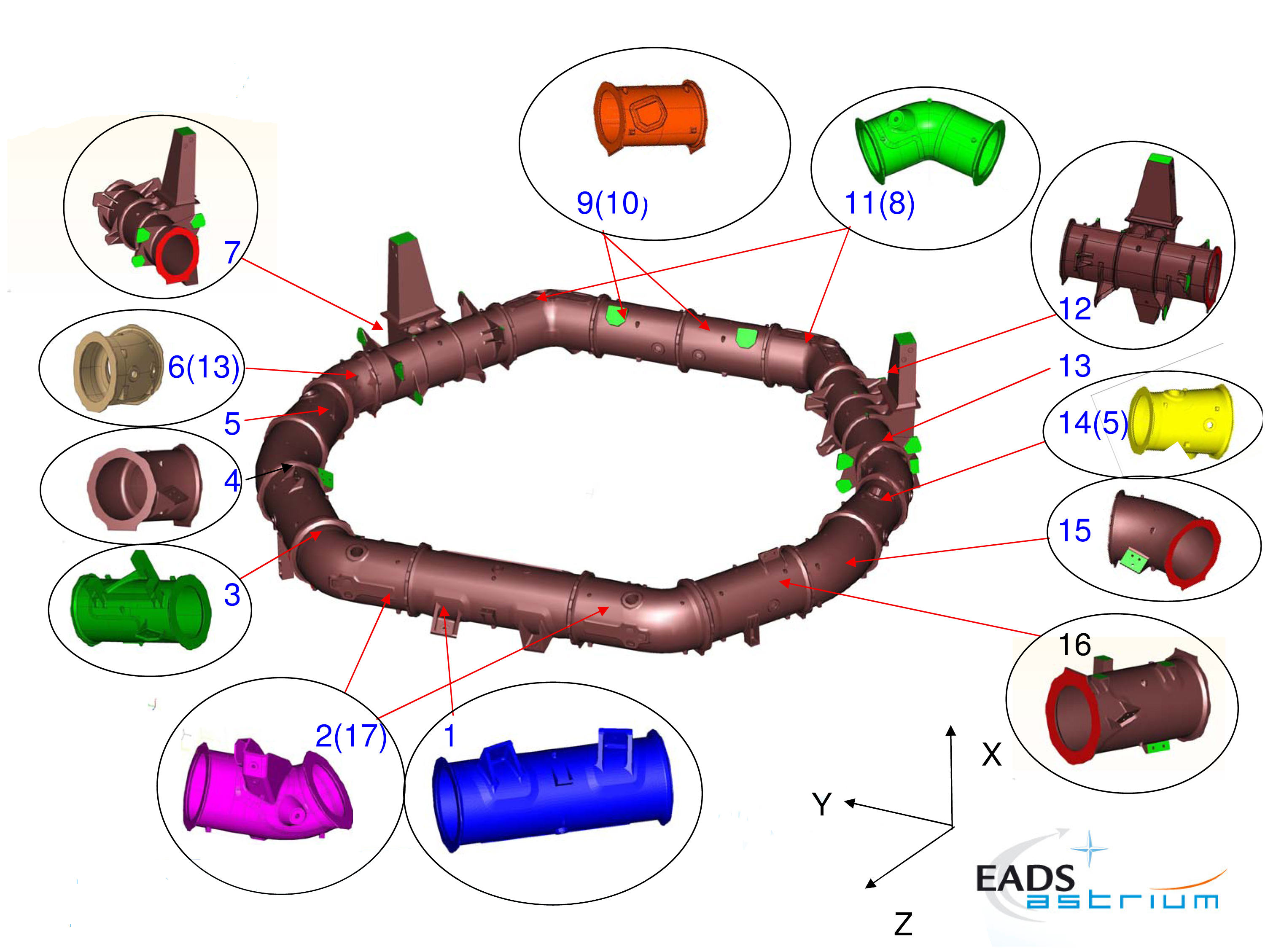
Schematic diagram of the Gaia torus

Date: 22 July 2009
Satellite: Gaia
Depicts: The Gaia torus
Copyright: EADS Astrium
The 3-metre diameter, quasi-octagonal torus, which will support the two Gaia telescopes and the focal plane assembly, is composed of 17 individual custom-built Silicon Carbide segments.
This schematic diagram shows the 17 unique shapes that comprise the torus.
All elements of the torus are constructed from Silicon Carbide (SiC), a ceramic material whose physical characteristics make it the material of choice for structures which must be both light-weight and robust. The low thermal expansion coefficient and high thermal conductivity of SiC mean that it is a very stable material which can quickly dissipate thermal gradients, and with a Young's Modulus of about 420 GPa it is twice as stiff as steel. These are essential properties for the key hardware components of a mission whose scientific goals include obtaining microarcsecond astrometry of 1 billion celestial objects.
The Gaia torus was built by BOOSTEC, a subcontractor to the Gaia prime contractor EADS Astrium.