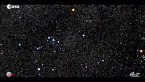
The future of the Orion constellation (speeded-up)
Date: 09 June 2017
Copyright: ESA/Gaia/DPAC, CC BY-SA 3.0 IGO
This is a speeded-up version of the video revealing how our view of the Orion constellation will evolve over the next 450 000 years. This version is 10 times faster than the original video; for illustrative purposes, it shows the stars moving several times forwards and backwards in time, between the present epoch and 450 000 years from now.
Amid a myriad of drifting stars, the shape of Orion as defined by its brightest stars is slowly rearranged into a new pattern as time goes by.
The portion of the sky depicted in the video measures 40 × 20° – as a comparison, the diameter of the full Moon in the sky is about half a degree.
The video is based on data from ESA's Gaia and Hipparcos satellites, as well as additional information from ground-based observations.
Full story: The future of the Orion constellation
The evolution of two million stellar positions on the entire sky is shown here.
This work is licensed under a Creative Commons Attribution-ShareAlike 3.0 IGO License.