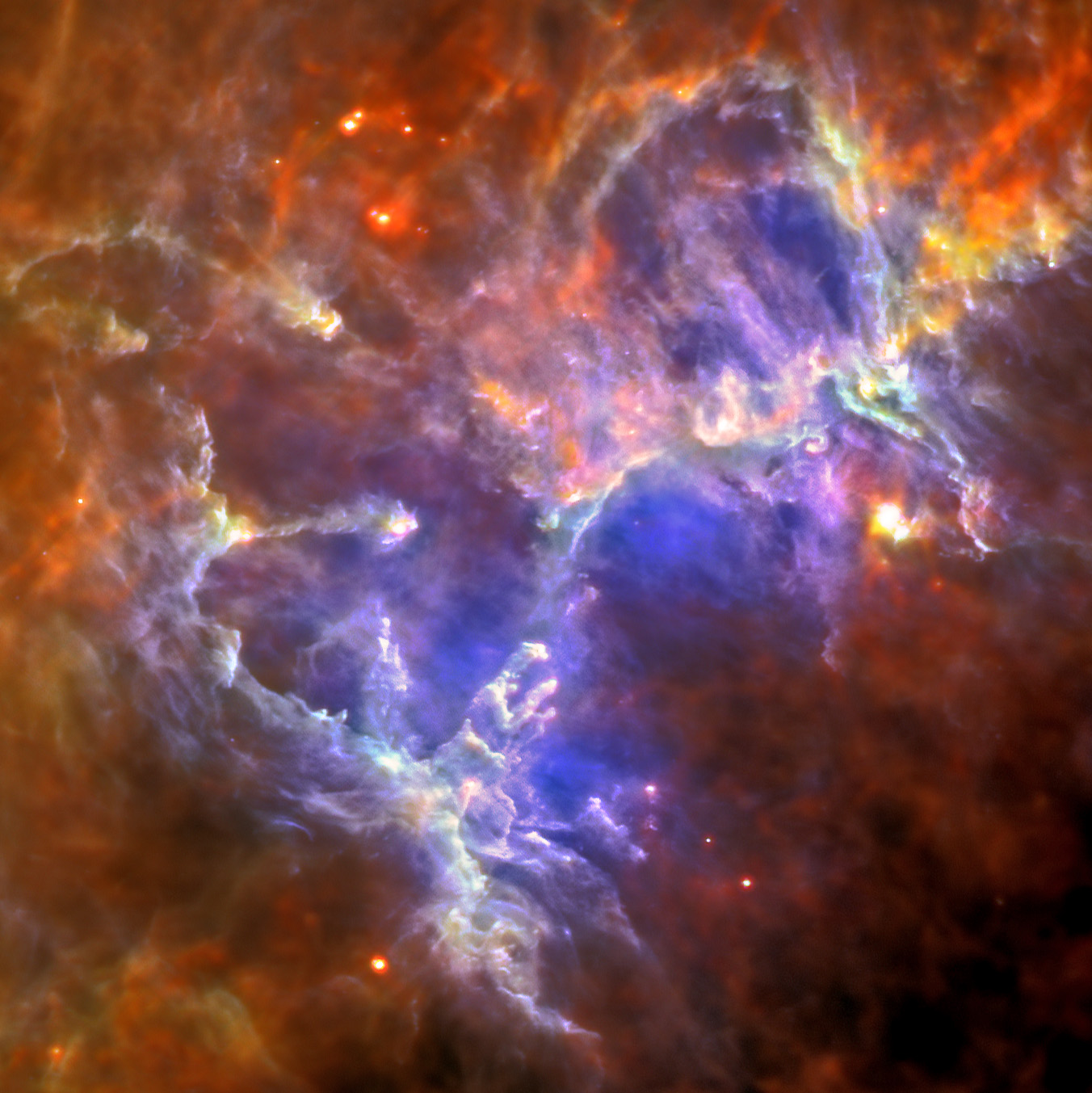
Herschel far-infrared view of Messier 16
 Date: 16 January 2012
Satellite: Herschel
Depicts: Messier 16
Copyright: ESA/Herschel/PACS/SPIRE/Hill, Motte, HOBYS Key Programme Consortium
Show in archive: true
This Herschel image of the Eagle Nebula, colour coded to 70 microns for blue and 160 microns for green using the PACS (Photodetector Array Camera) and 250 microns for red using the SPIRE (Spectral and Photometric Imaging Receiver) shows the self-emission of the intensely cold nebula's gas and dust as never seen before. Each colour shows a different temperature of dust, from around 10 degrees above absolute zero (10K) for the red, up to around 40K for the blue. In the far–infrared, the nebula shows its intricate tendril nature, with vast cavities forming an almost cave-like surrounding to the famous pillars, which take on an ethereal ghostly appearance. The gas and dust provide the material for the star formation that is still under way inside this enigmatic nebula.
Date: 16 January 2012
Satellite: Herschel
Depicts: Messier 16
Copyright: ESA/Herschel/PACS/SPIRE/Hill, Motte, HOBYS Key Programme Consortium
Show in archive: true
This Herschel image of the Eagle Nebula, colour coded to 70 microns for blue and 160 microns for green using the PACS (Photodetector Array Camera) and 250 microns for red using the SPIRE (Spectral and Photometric Imaging Receiver) shows the self-emission of the intensely cold nebula's gas and dust as never seen before. Each colour shows a different temperature of dust, from around 10 degrees above absolute zero (10K) for the red, up to around 40K for the blue. In the far–infrared, the nebula shows its intricate tendril nature, with vast cavities forming an almost cave-like surrounding to the famous pillars, which take on an ethereal ghostly appearance. The gas and dust provide the material for the star formation that is still under way inside this enigmatic nebula.
Last Update: 1 September 2019