
Instruments
Introduction
The Huygens Probe is the ESA-provided element of the joint NASA/ESA Cassini-Huygens mission to Saturn and its largest moon, Titan. Huygens is an entry probe that will descend through Titan's atmosphere under a parachute system to the moon's surface. The probe is being carried to Titan on board the Cassini Saturn orbiter. Huygens is dormant during the journey to the Saturnian system and for the first six months in orbit around Saturn, with the exception of six-monthly in-flight checkouts to verify the health of the payload and to perform periodic maintenance and calibration of the instruments.
The scientific objectives of the Huygens mission are to perform detailed measurements of the physical properties, the chemical composition and the dynamics of Titan's atmosphere and to characterise the surface of the moon along the descent ground track and near the landing site.
Huygens is a sophisticated robotic laboratory equipped with six scientific instruments provided by Principal Investigator institutions.
|
Huygens Instruments | ||
|
Instrument |
Principal Investigator | |
|
ACP |
Aerosol Collector and Pyrolyser |
|
|
DISR |
Descent Imager and Spectral Radiometer |
|
|
DWE |
Doppler Wind Experiment |
|
|
GCMS |
Gas Chromatograph and Mass Spectrometer |
|
|
HASI |
Huygens Atmospheric Structure Instrument |
|
|
SSP |
Surface Science Package |
|
Instruments in Brief
ACP
ACP (Aerosol Collector and Pyrolyser) will collect aerosols that will be analysed by the Gas Chromatograph and Mass Spectrometer experiment. It is equipped with a deployable sampling device that will be operated twice during the descent. The first sample will be taken from the top of the atmosphere down to an altitude of about 40 km. The second sample will be collected in the cloud layer, between altitudes of about 23 km and 17 km. After extension of the sampling device, a pump draws the atmosphere and its aerosols through a filter in order to capture the aerosols. At the end of each collection period, the filter is retracted into a pyrolysis furnace where the material from the captured aerosols is analysed, first at ambient temperature
|
ACP Measurements | |
|
Sampling altitudes |
|
|
Pyrolysis temperatures |
|
DISR
DISR (Descent Imager and Spectral Radiometer) is an optical remote sensing instrument. It includes a set of upward and downward looking photometers, visible and infrared spectrometers, a solar aureole sensor, a side-looking imager, and two down-looking imagers - one providing medium resolution and the other high resolution. There is also a sun sensor that will measure the spin rate of the probe. DISR will make measurements in the
|
DISR Measurements | |
|
Upward and downward looking photometer |
Violet light |
|
Spectrometers |
|
| Downward and side-looking imagers | |
| Solar aureole photometer | 550 nm, 939 nm |
DWE
DWE (Doppler Wind Experiment) is designed to determine the direction and strengh of Titan's zonal winds. A height profile of wind velocity will be derived from the residual Doppler shift of Huygens radio relay signal as received by Cassini. This will be corrected for all known probe and orbiter motions and signal propagation effects. Wind-induced motion of the probe will be measured with a precision better than
|
DWE Measurements | |
|
(Allen variance)1/2 |
|
|
Corresponding wind velocities |
|
GCMS
GCMS (Gas Chromatograph and Mass Spectrometer) is designed to measure the chemical composition of Titan's atmosphere from 170 km to the surface and determine the isotope ratios of the major gaseous constituents. It will also analyse gas samples from the ACP experiment and will investigate the composition of several candidate surface materials.
|
GCMS Measurements | |
|
Mass range |
|
|
Dynamic range |
|
| Sensitivity | |
|
Mass resolution |
|
HASI
HASI (Huygens Atmospheric Structure Instrument) is a multi-sensor instrument that will measure the physical and electrical properties of Titan's atmosphere. Its sensors suite consists of a
|
HASI Measurements | |
|
Temperature |
|
|
Pressure |
|
| Gravity | |
| DC E-field | |
| Electrical conductivity | |
| Relative permittivity | |
|
Acoustic properties |
90 dB at 5 mPa |
SSP
SSP (Surface Science Package) is a suite of sensors for determining the physical properties of the surface at the landing site and for providing information on the composition of the surface material. The instrument includes a force transducer for measuring the impact deceleration and sensors to measure the refraction index, temperature, thermal conductivity, heat capacity, speed of sound and dielectric constant of the surface material. The instrument suite includes an acoustic sounder for sounding the bottom layer of the atmosphere and the physical properties of the surface prior to landing. If the Probe lands in a liquid, the sounder will be used to probe the liquid depth. A tilt sensor is included to indicate the Probe's attitude after landing.
|
SSP Measurements | |
| Gravity | |
| Tilt | |
| Temperature | |
| Thermal conductivity | |
| Speed of sound | |
| Liquid density | |
| Refractive index | |
| Acoustic sounder | |
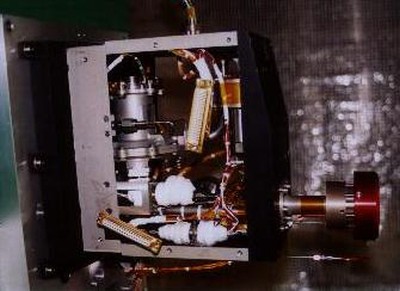
ACP: Aerosol Collector and Pyrolyser
The Aerosol Collector and Pyrolyser will deploy a filter out in front of the probe to sample the aerosols during the descent and prepare the collected matter (by evaporation, pyrolysis and gas product transfer) for analysis by the Gas Chromatograph Mass Chromatograph (GCMS). Two samples will be collected: one from the top of the descent down to the tropopause
 |
|
Aerosol Collector and Pyrolyser |
Scientific Objectives
To study:
- The chemical composition of the photochemical aerosols -
hydrogen (H), carbon (C), nitrogen (N) andoxygen(O) - The relative concentrations of the organic condensates inside the lower stratosphere (C2, H2, C2, H, HC3N, HCN)
- The relative concentrations of the organic condensates within the troposphere (mainly CH4, C2H6)
- Non condensable constituents trapped in the collected particles (CO2)
Instrument Characteristics and Operations
- Sampling of the particles (direct impact plus capture by filtration)
- two sampling regions:
140 - 32 km and22 - 17 km - target for captation outside the boundary layer of the Probe, near the Probe nose is retracted and enclosed in the oven
- heating and pyrolysis of the collected matter, in the oven, gives evaporates (250
°C ) and pyrolysates (600°C ) - transfer of the evaporates and pyrolysis products to the GCMS (via the special ACP inlet)
- analysis (direct MS and GCMS)
- designed to operate with precise timing.
DISR: Descent Imager/Spectral Radiometer
Sunlight plays a key role in driving many important physical processes in planetary physics. Absorption of ultraviolet light drives photochemical reactions, leading to changes in atmospheric composition and to the production of atmospheric aerosols. The size, shape, composition, and distribution of aerosols and cloud particles determine their optical properties and their ability to absorb sunlight and emit thermal infrared radiation, thus playing a key role in the thermal balance of the atmosphere. The net radiative heating or cooling rate provides the forcing for atmospheric dynamics, which in turn can affect the distribution of aerosol and cloud particles and climate. The composition, thermal balance, dynamics, and meteorology of the atmosphere also affect (and are affected by) the nature of the surface. Images of the surface in reflected sunlight together with near infrared reflection spectra can reveal the nature of the surface and its interactions with atmospheric processes. Thus, optical measurements in the wavelength of solar radiation made inside a planetary atmosphere can reveal a great deal about many important physical processes occurring there.
The Descent Imager/Spectral Radiometer (DISR) is the optical instrument that makes measurements at solar wavelengths aboard the Huygens Probe of the Cassini mission. This instrument is being developed in a collaborative effort by scientists from the US, France, and Germany. DISR measures solar radiation using silicon photodiodes, a two-dimensional silicon Charge Coupled Device (CCD) detector and two InGaAs near-infrared linear array detectors. The light is brought to the detectors using fibre optics from many separate sets of foreoptics that collect light from different directions and in different spectral regions. In this way the instrument can make a suite of measurements which are carefully selected to answer key questions concerning the nature of the surface and the composition, meteorology, thermal balance, and clouds and aerosols in the atmosphere of Titan.
DISR Scientific Objectives
Thermal Balance and Dynamics
The first objective of DISR is to measure directly the vertical profile of the solar heating rate. This will be done using measurements of the upward and downward solar flux over the spectral interval from 0.35 to 1.7pm from 160 km to the surface at a vertical resolution of approximately 2 km. The downward flux minus the upward flux gives the net flux, and the difference in the net flux at two altitudes gives the amount of solar energy absorbed by the intervening layer of atmosphere. This basic measurement gives an important quantity for understanding the thermal balance of Titan's atmosphere.
From other Huygens measurements of the temperature profile and the gaseous composition, the science team plans to model the radiative cooling rate at wavelengths in the thermal infrared. An important contribution to this calculation will be the measurements of the size, shape, optical properties, and vertical distribution of aerosol and cloud particles determined by other DISR measurements. The combination of the measured solar heating rate with the computed thermal cooling rate will give the net radiative drive for atmospheric dynamics. Model computations can be used to estimate the wind field from the radiative forcing.
Finally, the science team plans to measure the horizontal wind direction and speed as functions of altitude from images of the surface obtained every few kilometres in altitude which will show directly the drift of the probe over the surface of Titan. The measured wind speed and direction determined by DISR can be compared to the wind field computed from the net radiative forcing determined above.
Distribution and Properties of Aerosol and Cloud Particles
Several properties of the cloud and aerosol particles are important for understanding their interaction with solar and thermal radiation field. The size of the particles compared to the wavelength of the radiation is important for understanding their scattering properties. Measurements of both the forward scattering and polarising nature of the aerosols on Titan have been used to show that spherical panicles can not simultaneously explain these two types of observations. We are therefore interested in knowing particle shape as well as size. The vertical distribution of the particles is obviously important for knowing their influence on the profiles of solar and thermal radiation. Finally, a suite of optical properties are needed as functions of wavelength to permit accurate computations of the interactions of the particles with radiation. These include the optical depth, single scattering albedo, and the shape of the scattering phase function. These properties together with the determinations of size and shape can yield the imaginary refractive index (and possibly constrain the real refractive index also) and thus constrain the composition of the particles.
We plan to measure as many of these properties as possible by combinations of measurements of small angle scattering in the solar aureole in two colours, by measurements of side and back scattering in two colours and two polarisation's, by measurements of the extinction as a function of wavelength from the blue to the near infrared, and by measurements of the diffuse transmission and reflection properties of layers in the atmosphere.
Nature of the Surface
The surface of Titan was hidden from view of the cameras aboard the Pioneer and Voyager spacecraft by the layers of small haze particles suspended in the atmosphere. Nevertheless, intriguing suggestions regarding the nature of the surface have been made, including the possibility that the surface consists of a global ocean of liquid methane ethane. Radar observations and direct observations at longer wavelengths strongly hint that the surface is not a global ocean. The range of fascinating surfaces observed by the Voyager mission on satellites of the outer solar system showed a surprising range of phenomena including craters, glacial flows, frost and ice coverings, and active geysers and volcanoes. These preliminary explorations of the small bodies of the outer solar system suggest that the surface of Titan also may well contain new surprises.
We plan to measure the state (solid or liquid) of the surface near the probe impact site, and to determine the fraction of the surface that is solid and liquid in this region. We plan to measure the topography of the surface, and explore the range of physical phenomena that have formed the surface. We plan to measure the reflection spectra of surface features from the blue to the near infrared in order to constrain the composition of the different types of terrain observed. In addition, we plan to image the surface at resolution scales from hundreds of meters (similar to those accessible from the orbiter) to tens of centimetres over as large an area as possible to study the physical properties occurring on the surface and to understand the interactions of the surface and the atmosphere.
Composition of the Atmosphere
The Huygens Probe contains a mass spectrometer/gas chromatograph to measure directly the composition of the atmosphere. Nevertheless, direct sampling techniques can have problems with constituents that can condense in the atmosphere should a cloud particle enter and slowly evaporate in the sampling system of such an instrument. The DISR will provide an important complementary capability by being able to record the spectrum of the downward streaming sunlight which shows the absorption bands of methane, the most likely condensable constituent. The observations of the visible and near infrared absorption bands of methane will be used to determine the profile of the mixing ratio of methane gas during the descent of the Huygens Probe.
Methane can exist as a solid, liquid, or gas on Titan, and has been suggested to play a role in the meteorology of Titan similar to the role played by water on the Earth. Our measurements of methane mixing profile will be analogous to a relative humidity profile on the Earth.
Finally, the atmosphere of Titan is believed to consist primarily of nitrogen, methane and argon. Our measurements of the mixing ratio of methane together with the determination of total mean molecular weight of the atmosphere by radio occultation measurements made by the Cassini Orbiter will indirectly yield the argon to nitrogen mixing ratio as an important backup to the mass spectrometer measurements planned fort he Huygens Probe.
DISR Instrument Overview
- CCD detector fed by:
- three imagers
- upward and downward-looking spectrometers
- solar aureole camera (2 colours, 2 polarisation states)
- Two linear IR detector arrays
- upward and downward-looking infrared spectrometers
- upward and downward-looking violet photometers
- Surface Science Lamp
- Sun Sensor
- Inflight Calibration System
- Hardware and software data compression systems
- Flexible data collection software
- Three frame imagers:
- Passband from 660 to 1000 nm at 0.06°, 0.12o and 0.20° per pixel
- Complete coverage in azimuth from 6° to 96° nadir angle in 36-exposure sets
- Upward and downward-looking IR spectrometer
- 132 spectral pixels from 850 to 1700 nm
- Diffuser looking up, image spot at 20° nadir angle looking down
- Upward and downward-looking visible spectrometer:
- 200 spectral pixels 480 to 960 nm; diffuser with shadow bar looking up
- 10 40 × 40 resolution elements from 10° to 50° nadir looking down
- Upward and downward-looking violet photometer:
- Diffusers looking up (with shadow bar) and down; 350 to 480 nm passband
- 4-channel solar aureole camera:
- 6° wide strip from 25° to 75° zenith angle centred 60° and 180° from azimuth of Sun
- Passbands at 500 and 935 nm, each in vertical and horizontal linear polarization
- Lamp for measurement of reflection spectrum of surface below 100 m altitude
- Sun sensor to measure solar azimuth and zenith angles and brightness at 939 nm.
|
DISR Measurement Capability | ||||||
| Upward Looking Instrument | ||||||
|
Azmth Range |
Zenith Range |
Spectral Range |
Spectral Scale (per pixel) |
Spatial Scale (per pixel) |
Pixel Format | |
|
Violet Photometer (ULV) |
170 |
5-8 |
350-480 |
- |
- |
1 |
|
Visible Spectrometer (ULVS) |
170 |
5-8 |
480-960 |
2.4 nm |
- |
8×200 |
|
Infrared Spectrometer (ULIS) |
170 |
5-8 |
870-1700 |
6.3 nm |
- |
132 |
|
Solar Aureole (SA 1) Vertical polarisation |
6 |
25-75 |
500 ±25 |
- |
1 |
6×50 |
|
Solar Aureole (SA 2) Horizontal polarisation |
6 |
25-75 |
500 ±25 |
- |
1 |
6x50 |
|
Solar Aureole (SA 3) Vertical polarisation |
6 |
25-75 |
935 ±25 |
- |
1 |
6x50 |
|
Solar Aureole (SA 4) Horizontal polarisation |
6 |
25-75 |
935 ±25 |
- |
1 |
6x50 |
|
Sun Sensor (SS) (64° cone FoV) |
64 |
25-75 |
939 ±6 |
- |
- |
1 |
| Downward Looking Instrument | ||||||
|
Azmth Range |
Zenith Range |
Spectral Range |
Spectral Scale (per pixel) |
Spatial Scale (per pixel) |
Pixel Format | |
|
Violet Photometer (DLV) |
170 |
5-88 |
350-480 |
- |
- |
1 |
|
Visible Spectrometer (DLVS) |
4 |
10-50 |
480-960 |
2.4 nm |
2 |
20x200 |
|
Infrared Spectrometer (DLIS) |
3 |
15.5-24.5 |
870-1700 |
6.3 nm |
- |
132 |
|
High Resolution Imager (HRI) |
9.6 |
6.5-21.5 |
660-1000 |
- |
0.06 |
160x256 |
|
Medium Resolution Imager (MRI) |
21.1 |
15.8-46.3 |
660-1000 |
- |
0.12 |
176x256 |
|
Side Looking Imager (SLI) |
25.6 |
45.2-96 |
660-1000 |
- |
0.2 |
128x256 |
DWE: Doppler Wind Experiment
The Doppler Wind Experiment (DWE) is a high-precision tracking investigation to determine wind direction and magnitudes in Titan's atmosphere. DWE measures the Doppler Shift or the Probe Relay Link Signal from the Huygens Probe to the Cassini Orbiter. The DWE-proper hardware consists of two Ultra-Stable Oscillators, one on the Probe and one on the Orbiter.
DWE Scientific Objectives
Primary Science Objectives
- Determine the height profile of Titan zonal wind velocity over the altitude range from
0 - 160 km with an accuracy of~ 1 ms-1
Secondary Objectives
- Measure Doppler fluctuations to determine the level and spectral index of turbulence and possible wave activity in Titan's atmosphere
- Measure Doppler and signal level modulation to monitor Probe Descent Dynamics, including its rotation rate and phase, parachute swing and post-impact status
|
DWE Ultra Stable Oscillator | ||
| Physical parameters | ||
|
Mass (g) |
1898 |
radiation shielding: 150 g |
|
Dimensions (mm) |
170 × 117 × 119 |
L × W × H |
| DC power | ||
|
Warm-up power (W) |
< 18.4 |
< 30 min |
|
DC consumption (mA) |
< 675 |
System limit: 0.7 A |
|
Energy (Wh) |
|
worst case (minimum temp) |
|
Frequency parameters | ||
|
Output frequency (MHz) |
10 |
± 0.1 Hz |
|
Frequency long term drift |
|
|
|
Allen variation
|
|
|
|
|
| |
GCMS: Gas Chromatograph and Mass Spectrometer
The Gas Chromatograph and Mass Spectrometer (GCMS) will measure the chemical composition of Titan's atmosphere from 170 km altitude (approx. 1 mbar) to the surface (approx. 1.5 bar) and determine the isotope ratios of the major gaseous constituents. GCMS will also analyse gas samples from the Aerosol Collector Pyrolyser (ACP) and will be able to investigate the composition (including isotope ratio) of several candidate surface materials. GCMS is a quadrupole mass filter with a secondary electron multiplier detection system and a gas sampling system providing direct atmospheric composition measurements and batch sampling through three Gas Chromatograph (GC) columns.
GCMS Scientific Objectives
Analysis of the composition of the atmosphere of Titan is one of the most important goals of the Cassini-Huygens Mission. The scope of this problem is unusually large, including the determination of noble gas abundance, isotopic ratios, and the identification of high molecular weight organic compounds in trace quantities. Even the relative abundance of major constituents are poorly known, while the opportunities for minor constituent formation in this evolving atmosphere are so rich that it is not possible to predict with certainty just what substances to seek.
The payload addresses this challenge with a variety of instruments on the probe and the orbiter. This instrument provides in situ data along the track of the probe descent and a context for these results by remote sensing of the atmosphere. A versatile, sensitive Gas Chromatograph-Mass Spectrometer (GC-MS) on the probe is essential to the success of this strategy.
With a dynamic range of 108 the GCMS can identify atmospheric constituents over a mass range
Similarly, the vertical variations in mixing ratios of various organic compounds can be used to delineate the chemical processes leading to their formation. A search for new constituents will be conducted (even unpredicted ones) to a level of 10 parts per billion, identifying them with the aid of a computer-accessed library of mass spectra of thousands of organic compounds. By analyzing the output of the Aerosol Collector Pyrolyser (ACP), it will also be possible to study the end products of the atmospheric chemistry of Titan. These data will provide new insights into the mechanisms for chemical evolution on Titan and its possible relevance to prebiotic synthesis on the early Earth.
GCMS Instrument Overview
The main elements of the instrument are:
- A mass spectrometer system consisting of ion sources, mass analyzer and ion detector to permit species concentration measurements to be made
- A gas sample inlet system to reduce the ambient atmospheric pressure to a lower value which is acceptable for proper operation of the mass spectrometer ion source
- A sample enrichment system to increase the measurement capability of the instrument by selective physical and chemical treatment of atmospheric samples prior to their introduction into the ionization region of the ion source
- A gas chromatograph to increase the measurement capability of the instrument by batch sampling at specific points in the atmosphere and subsequent time separation of species with different chemical properties for detection and identification and analyses by the mass spectrometer
- A vacuum pump system to maintain proper operating pressures in the mass spectrometer while atmospheric gas samples, aerosol Pyrolyser products or gases eluting from the gas chromatograph are introduced into the ionization regions of the ion sources
- A sample transfer system for the gas mixtures generated by the Aerosol Collector Pyrolyser (ACP) to the mass spectrometer sample inlet systems
The mass spectrometer employs five ion sources selectably feeding a common mass analyzer. One of the five sources (IS1) is connected to the atmospheric input manifold. The second ion source (IS2) is connected to the output of the Aerosol Collector Pyrolyser (ACP), and three ion sources (IS3, IS4 and IS5) are connected to three gas chromatographic columns (GC columns).
During part of the descent the source choice is prescribed but for most of the time the choice will be determined in-flight based on a measurement of the effluent output of the three chromatographic columns. During the intervals when effluent from the GC columns is expected, the presence of a gas peak at the output, as determined by a measurement of the total abundance of gas with mass greater than the carrier gas, will signal priority status for the source connected to the eluting column. In the absence of such a peak, the source connected directly to the atmospheric manifold will be selected. During the intervals set aside for the ACP direct analysis, the associated source (IS2) will be selected and during the GC analysis of the ACP pyrolysis products, the priority interrupt will be identical to that associated with the atmospheric sample.
HASI: Huygens Atmosphere Structure Instrument
The Huygens Atmospheric Structure Instrument is a multi-sensor package designed to measure the physical properties of Titan's atmosphere. HASI will measure the temperature, the pressure, the turbulence, the atmospheric conductivity and will search for lightning. HASI will also address questions regarding the surface topography and dielectric properties.
The scientific objectives of the Huygens atmospheric Structure Instrument (HASI) are:
- Determine the density, pressure and temperature conditions corresponding to the higher part of the atmosphere during the entry phase. Of particular interest is the determination of the physical condition in this region where the "detached" haze, observed by Voyager, is formed.
- Measure the stratospheric density, T, P profile of the stratosphere during the descent phase and identify the composition in these layers in terms of trace constituents which condense in this part of the atmosphere. Interpret any data which may suggest the existence of clouds in the upper troposphere.
- Measure P,T in the lower troposphere and determine the existence and extent of a convective zone.
- Determine (in case of survival after impact) the nature of the surface.
- Determine the atmospheric electric conductivity and investigate ionisation processes, wave electric fields and atmospheric lightning. Detect acoustic noise due to turbulence and thunders. Characterise electric properties, conductivity and permittivity of the surface material.
- Determine the surface large scale and small scale topography, the surface dielectric properties and in particular to be able to remotely distinguish between a liquid or a solid surface before impact. If the surface is liquid, information on surface winds may be obtained. All data are measured along the ground track of the descending probe due to horizontal winds during the last 30 km.
|
HASI Sensor Packages | ||||
|
Sensor package |
Sensor type |
Accu- |
Resolution |
Measured parameter |
|
Accelerometers (ACC) |
|
1% |
< 1 µg |
Atmospheric deceleration, |
|
Pressure Profile Instrument (PPI) |
Kiel probe, capacitive gauges |
1% |
0.01 hPa |
Atmospheric pressure |
|
Temperature Sensors (TEM) |
|
0.5 K |
0.02 K |
Atmospheric temperature |
|
Permittivity, Wave & Altimetry (PWA) |
Mutual impedance |
10% |
|
Atmospheric electric conductivity, |
| AC field measurement | 2 µVm-1 (threshold) | |||
|
Relaxation probe |
10% |
1 min |
Ion conductivity and DC electric field | |
|
Acoustic sensor |
5% |
10 mPa |
Acoustic noise due to turbulence of storms | |
|
Radar signal processing (FFT) |
1.5 dB |
40 m |
Radar echoes below 60 km altitude | |
SSP: Surface Science Package
|
|
|
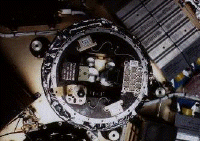
Surface Science Package |
SSP Scientific Objectives
- Determine the physical nature and condition of Titan's surface at the landing site
- Determine the abundances of the major constituents, placing bounds on atmospheric and ocean evolution
- Measure the thermal, optical, acoustic and electrical properties and density of any ocean, providing data to validate physical and chemical models
- Determine wave properties and ocean/atmosphere interaction
- Provide ground truth for interpreting the large-scale Orbiter Radar Mapper and other experimental data
SSP Instrument Overview
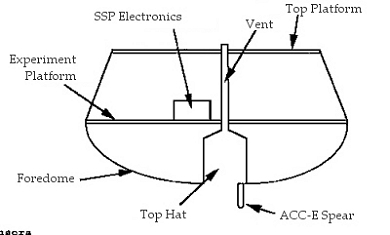
The SSP addresses its science objectives through a suite of nine measurement subsystems selected to provide at least partial characterisation of either a solid or a liquid surface at the landing site. Seven of the sensors require intimate contact with the surface material and are housed in a 100 x 100 mm square cross-section cavity, known as the top-hat, cut out of the Probe's foredome and extending to the main experiment platform. Venting of the top hat is achieved through a 5.5 mm inner diameter tube from the Top hat to the Probe's top surface.
|
|
|
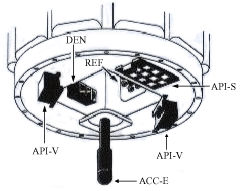
SSP Instruments |
Technical Description
The Huygens Probe in surface configuration is shown here in section. The accommodation for most transducer subsystems is shown, with a vent extending to the top platform. This vent ensures that access to Titan ocean fluid is available to those sensors that need it; it does not have to be a straight tube to fulfil this function. This 'Top Hat' configuration eliminates the need for either deployment mechanisms or the use of a large area of the front shield surface, thus avoiding competition with the radar altimeter antenna, ACP or GCMS inlets.
|
|
|
Schematic of Probe in surface configuration with components of Surface Science Package. |
Sensors
The complement of sensors used by the Surface Science Package are indicated below:
|
|
Impact penetrometer |
Piezoelectric type |
|
ACC-I |
Impact accelerometer |
Piezoelectric type |
|
TIL |
Tilt X |
Electrolytic type |
|
Tilt Y |
Electrolytic type | |
|
THP |
Thermal Properties |
Hot wire |
|
API-V |
Velocity of Sound |
Piezoelectric transducers (2) |
|
API-S |
Acoustic sounder |
Piezoelectric transducer |
|
PER |
Fluid permittivity |
Capacitance sensor |
|
DEN |
Density of fluid |
Archimedes sensor |
|
REF |
Refractive Index |
Critical angle refractometer with photodetector readout |
Note: The TTL X and Y axes do not correspond to Probe X and Y axes
Accelerometer (ACC)
The accelerometer subsystem will consist of two piezoelectric sensors mounted on a suitable structure, ensuring a known response of the Probe structure to surface contact, the penetrometer (ACC-E) on a spear, the other (ACC-I) on SSPE. The ACC-I will also measure atmospheric and surface accelerations.
Tilt Sensor (TIL)
The tilt sensors work on an electrolytic principle and consist of platinum terminals and a methanol based liquid enclosed in a sealed glass housing. Fluid damping is included to improve operation in moderate dynamic environments. An individual sensor element is very small and senses the local vertical about a single axis. Two elements will be used to give the tilt angle in any plane, and both are mounted on the electronics box. The TIL sensor shall be aligned with one axis on a radius from the platform/Probe central axis (to within 110).
Thermal Properties (THP)
The thermal properties sensor assembly makes measurements of the Titan ocean and lower atmospheric temperature and thermal conductivity. It is housed in the SSP Top Hat. Conventional sensors for this purpose are platinum wires 5 cm long and 10 and 25 microns in diameter. The thermal conductivity measuring technique is to pass a current through the wire to heat it and the surrounding medium. A series of resistance measurements are taken at approx. 0.1 s intervals to measure the rate of heating of the element and detect the onset of convection.
Acoustic Properties (API)
The acoustic properties sensors are small piezoelectric ceramic devices similar to those used in marine applications. There are three transducers: two are used in both transmit and receive modes alternatively for the velocity of sound measurement (API-V), the third is an array of elements used in dual mode for the acoustic sounder (API-S). The first two face each other across the diameter of the Top Hat. Propagation time between the transducers will be in the region of 150 microns. The third transducer points vertically downwards to obtain a return from the bottom of the ocean, or the Titan surface during descent. Atmospheric sounding may also be possible with API-S.
Fluid Permittivity (PER)
The PER sensor consists of simple electrodes, within the Top Hat experimental volume, whose capacitance will vary with the permittivity of the material between them. In addition, a conductivity measurement (CON) will be made. This may provide a measure of any polar molecules in any Titan ocean.
Fluid Density (DEN)
The density of any Titan ocean shall be determined using an Archimedes buoyancy sensor, the displacement of a float by the surrounding liquid medium being determined by the use of four strain gauges in a bridge arrangement.
Ref ractometer (REF)
The refractive index sensor is a specially shaped prism with two LED light sources providing internal or external illumination to the curved surface of the prism through light guides. Light passing through the top surface of the prism will be fed into a linear photodiode array. All of these components will be built into the Top Hat sensor assembly. The refractive index is determined from the position of the light/dark transition on the photodiode array.