
SMART-1 Mission to the Moon: Technology and Science Goals
Abstract
B.H. Foing1, G.D. Racca², A. Marini², D.J. Heather1, D. Koschny1, M. Grande³, J. Huovelin4, H.U. Keller5, A. Nathues5, J.L. Josset6, A. Malkki7, W. Schmidt7, G. Noci8, R. Birkl9, L. Iess10. Sodnik11, P. McManamon11
1ESA Research and Scientific Support Department, ESTEC/SCI-SR, Postbus 299, 2200 AG Noordwijk, The Netherlands, ²ESA Scientific Project Department, ESTEC/SCI-PD ³Rutherford Appleton Labs, UK, 4Helsinki Observatory, 5Max- Planck- Institut. für Aeronomie, 6Space-X, Neuchatel, 7Finnish Meteorology Institute, 8LABEN SpA, 9Astrium GmbH, 10U. of Rome, 11ESA Directorate of Technology and Operations , ESTEC/TOS
SMART-1 is a technology demonstration mission for deep space solar electrical propulsion and technologies for the future. SMART-1 will be Europe's first lunar mission and will contribute to developing an international program of lunar exploration. The spacecraft has been readied in April 2003 for a launch in summer 2003, as an auxiliary passenger to GTO on Ariane 5, to reach the Moon after 15 month's cruise. SMART-1 will carry six experiments, including three remote sensing instruments that will be used during the mission's nominal six months in lunar orbit. These instruments will contribute to key planetary scientific questions, related to theories of lunar origin and evolution, the global and local crustal composition, the search for cold traps at the lunar poles and the mapping of potential lunar resources.
Publication date: March 2003
Solar Electric Propulsion to the Moon
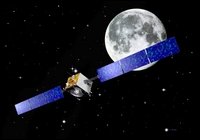
SMART (Small Missions for Advanced Research in Technology) are technology demonstration missions offering an early opportunity for science as well as a new management approach. ESA's SMART-1 mission (e.g. Foing et al., 2001; Racca et al., 2002; Marini et al., 2002) is specifically designed to test technologies to be used on future ESA cornerstone programs. Its main rationale is to demonstrate Deep Space Electric Propulsion and other technologies for future interplanetary and deep space missions. SMART-1 is the first approved European mission to visit the Moon. SMART-1 is being tested and readied for March 2003, for possible launch in mid 2003 on an Ariane 5 as an auxiliary passenger into Standard Geostationary Transfert Orbit (GTO).
 |
|
Artist's view of the SMART-1 |
The use of solar electric propulsion to carry the craft from within the Earth's gravity gravity-well during the 15-18 month cruise phase will allow valuable cruise science and in-flight calibration to be completed prior to arrival at the Moon, after which a nominal six month lunar mapping phase will begin, with the possibility of an extension if instrument and spacecraft conditions permit.
The baseline lunar orbit is highly elliptical, with a perilune between 300 and 1000 km close to the lunar south pole. The apolune will initially be around 10 000 km but will be lowered if sufficient fuel remains, so as the science return of the mission can be optimised optimised during the lunar mapping phase. It is hoped that apolune reduction will be completed immediately in order to complete the nominal six six-month mapping of the Moon prior to any significant degradation of the instruments.Instruments and Overall Science Objectives
Six instruments will be operating in all mission phases (cruise/lunar), performing 10 distinct science and technology investigations (Table 1). Science instruments, led by Principal Investigators (PIs) were mostly funded from PIs and co-Is national sources. Technology Experiments, led by Technology Investigators (TIs) were partly funded by ESA. Three instruments are used for spacecraft and planetary environment studies: Electric Propulsion Diagnostic Package (EPDP), Spacecraft potentialPotential, Electron and Dust Experiment (SPEDE) and Radio Science Investigation with SMART-1 (RSIS). Lunar exosphere studies are planned for EPDP and SPEDE. Three instruments are used for lunar remote sensing: the global X-ray mapping spectrometer (D-CIXS), near infrared spectral mapping spectrometer (SIR), and the localised high spatial resolution colour imaging camera of the lunar surface (AMIE). Overall science objectives for the mission are shown in Table 2.
| Instrument | Mass (kg) |
Power (W) | |
| EPDP | (Electric Propulsion Diagnostic Package) | 2.4 | 18 |
| SPEDE | (Spacecraft Potential Electron and Dust Exp.) | 0.8 | 1.8 |
| KATE | (ka-Band TT&C Experiment) | 6.2 | 26 |
| RSIS | (Radio-Science Investigations for SMART-1) | (using KATE & AMIE) | |
| D-CIXS | (Demo Compact Imaging X-ray Spectrometer) | 5.2 | 18 |
| XSM | (X-ray Solar Monitoring) | (with D-CIXS) | |
| SIR | (SMART-1 Infrared Spectrometer) | 2.3 | 4.1 |
| AMIE | (Advanced Moon micro-Imager Experiment) | 2.1 | 9 |
| Laserlink | (Experimental Deep-space Laser link) | (using AMIE) | |
| OBAN | (On-Board Autonomous Navigation Exp.) | (using AMIE) | |
Table 1. SMART-1 Instruments and Investigations
| Cruise Science |
| - Earth and magnetospheric imaging |
| - X-ray monitoring of Sun & cosmic sources |
| Lunar Science |
| - First global X-ray mapping of Mg, Al, Si (50 km resolution) |
| - First infrared spectral mineralogy mapping 0.9-2.5 |
| - Colour imaging via 0.75, 0.9, 0.95 µm + clear white channels |
| - Local multiband mapping at 30 µm resolution from 300 km |
| - Polar areas illumination and resource mapping |
Table 2. Overall Science Measurement Objectives for SMART-1
D-CIXS
 |
|
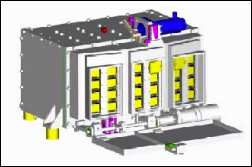
D-CIXS mid-term design |
| PI: M.Grande (RAL), co-I's UK, FIN, F, E, S, ESA |
| - Demonstration of a compact X-ray imaging spectrometer (12 x 32 deg FOV) |
| - Global mapping of the lunar surface (elemental composition) via X-ray fluorescence |
| - X-ray celestial sources, Earth aurora and magnetotail |
| - New technologies: Micro-structure collimator |
| - Swept Charge Devices (Detectors) 0.5 - 10 keV |
| XSM - PI: J. Huovelin (Obs. Helsinki - FIN) |
| - Si-pin detectors 104° FOV; range: 0.8-20 keV |
| - Solar X-ray flares and coronal monitoring (calibration) |
Table 3. D-CIXS X-ray instrument and solar X-ray monitor (XSM) objectives
 |
|
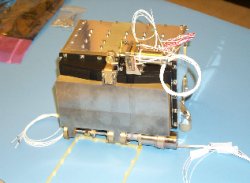
D-CIXS flight unit |
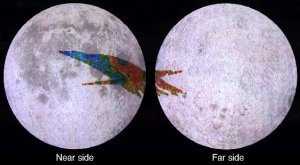
Bulk crustal composition has bearing on theories of origin and evolution of the Moon. D-CIXS will produce the first global view of the lunar surface in X-ray fluorescence (XRF), elemental abundances of Fe, Mg, Al and Si (and Fe plus others if solar activity permits) across the whole Moon. For some local areas mapped at times of solar flares, D-CIXS will have the sensitivity to measure Fe fluorescence. Otherwise, for comparison with global Fe maps, we shall use Fe data from Lunar Prospector (Lawrence et al 2002). The South Pole-Aitken Basin (SPA) and large lunar impact basins will be also mapped with D-CIXS. These will be the first XRF measurements of the lunar surface since the Apollo 15 and 16 missions, which covered just 9% of the Moon and were restricted to equatorial regions (Figure 13, Clark and Adler, 1978). More importantly, rather than the elemental ratios derived from the Apollo measurements, D-CIXS will derive absolute elemental abundances, by measuring (with X-ray Solar Monitor XSM) the incident solar spectrum that causes the lunar surface to fluoresce in X-rays.
 |
|
Map of the Al/Si ratio from the Apollo X-ray fluorescence (XRF) data (Courtesy of NASA, after Clark and Adler, 1978). The Apollo measurements cover just 9% of the lunar surface. D-CIXS will derive global maps of absolute abundances of the rock forming elements Mg, Si, Al. The D_CIXS data will be correlated with other elemental abundance maps obtained recently by the Lunar Prospector gamma-ray and neutron spectrometers. |
D-CIXS will provide a global distribution of Mg and permit the production of global magnesium numbers (Mg# = Mg/Mg+Fe). The mapping of Mg# = Mg/Mg+Fe is a key to study the evidence of a primitive source, the relations of Mg-suite rocks vs ferroan anorthosites or KREEP, and the constraints on the magma ocean model/ evolution. Although geochemical studies show the Mg-suite appears to have originated from both primitive and evolved sources, recent work by Shearer and Papike (1999) suggests that the Mg# is the only attribute to show evidence of a primitive source. All other elements suggest the rocks to have formed from evolved magmas.
A number of petrogenetic models that could produce this dichotomy in Mg-suite rocks were presented that range from an impact origin to the remelting of a magma ocean or cumulate pile (Shearer and Papike, 1999). A magma ocean model will produce Mg-suite rocks that exhibit specific relations to other rock types, perhaps displaying an association with ferroan anorthosites or KREEP materials, so a D-CIXS' more comprehensive characterisation of these Mg# will aid estimates of bulk crustal composition and theories for the evolution of the lunar crust, which in turn. D-CIXS will help to address this critical issue to models of the thermal and physical evolution of the Moon.
SIR
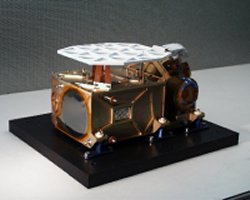
The near infrared point-spectrometer SIR (Table 4; Fig. 4), with 256 spectral channels over the range 0.93 to 2.4 mm, will map the mineral composition s across the lunar surfacewhole Moon, with a maximum spatial resolution of 300 m from perilune (Keller et al. 2003) .
| TI: H.U. Keller (MPAe - D); Co-I's D, Pl, UK, IRL, + ESA |
| Technology Objectives |
| - Flight qualification of a miniature monolithic grating spectrometer derived from commercial device (ZEISS) |
| - 0.93 - 2.4µm, 256 channels, resolution 6 nm/pixel. |
| - Correlation to AMIE 950 nm filter |
| Science objectives: |
| - Near infrared point-spectrometer, mapping of the lunar surface in NIR, lunar southern hemisphere (up to 300 m spatial resolution) |
| - Absolute flux calibration |
| -angular Spectroscopy of selected surface features (angular resolved in scan mode) |
|
- Lunar Spectral mapping: |
| - Discrimination of the major rock forming minerals - Olivine from mantle: crustal differentiation/evolution - SPA exposed materials from mantle - Investigation of Space Weathering and illumination geometry effects |
| - SIR highest spatial resolution will allow detailed exploration of central peaks, walls, rims and ejecta blankets of large impact craters, giving the stratigraphy of the lunar crust |
 |
|
Optical Unit of the SIR infrared spectrometer |
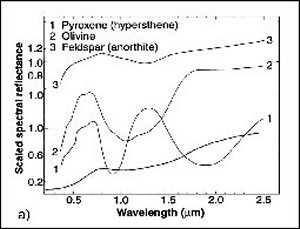
SIR will give the opportunityhave high enough spectral resolution to separate the pyroxene and olivine signatures in lunar soils (Figure 5). This is a key in our understanding of the evolution of crustal materials, as the distribution of olivine is poorly constrained in current models. Olivine is considered by many to be a common mineral in the lunar mantle (e.g. Lucey et al., 1998), so its distribution throughout the lunar crust and across the lunar surface is of critical importance to models of crustal differentiation and evolution. A key target for observations using the SIR instrument will be the 2500 km diameter South Pole-Aitken Basin (SPA), which may have dug through to expose materials from the lunar mantle (Lucey et al., 1998). This is strongly debated, however, and many consider the anomalously mafic units in the region to represent lower crustal materials rather than lunar mantle units (e.g. Pieters et al., 1997). If measurements of the olivine and pyroxene distribution throughout the SPA can be made, the results would have a strong bearing on this contentious issue and would allow for improved models of crustal differentiation and thermal evolutionary models. SIR will help to further this study.
SIR data will help to refine compositional analyses from Clementine/ Lunar Prospector data. IR spectrometry, with highest spatial resolution as good as 300 m will permit to resolveto distinguish units on the central peaks, walls, rims and ejecta blankets of large impact craters, allowing for stratigraphic studies of the lunar crust.
Observations of small diameter craters showing a wide age range will help studies of the influence of space weathering on reflectance spectra. Furthermore, the SMART-1 target pointing will allow SIR to take nearly continuously spectra while the phase angle is changing. The data obtained will allow for the extraction of phase angle influences.
 |
|
Reflectance spectra of key lunar minerals at UVVIS |
The NIR measurements up to 2.4 µm that will be provided by SIR will allow for the separation of the mineralogicalpyroxene and olivine signatures.
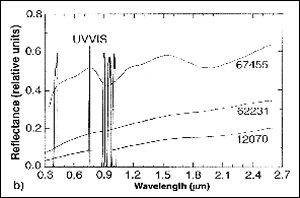
The plot below shows the spectra of some lunar samples, overlain by the wavelengths of the five filters from Clementine's UVVIS camera, which only cover the range from 0.4 to 1 mm and do not allow for this differentiation. AMIE filters correspond to 0.75, 0.9, and 0.96 mm.
 |
|
Reflectance spectra of key lunar minerals at UVVIS |
AMIE
 |
|
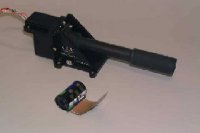
Fig.6 AMIE camera optical and unit |
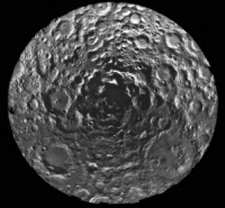
The micro camera AMIE (Josset et al 2003) will provide high-resolution CCD images of selected lunar areas (Table 5 lists the broad objectives of the camera). It includes filters deposited on the CCD in white light + three filters for colour analyses, with bands at 750 nm, 900 nm and 950 nm. These will provide data on the 1 mm absorption of pyroxene and olivine. The camera will have an average resolution of 80 m/pixel, and 30 m/pixel near a 300 km the perilune. AMIE images will provide a geological context (Figures 9 & 10) for SIR and D-CIXS data, and colour or multi-phase angle complement (Muinonen et al 2002). Lunar south pole (Figure 8) repeated and deep high resolution images will be obtained. This will allow the identification of shadowed or double-shadowed areas, the search for potential 'water ice traps' or 'cold traps'. Also, SMART-1 will map potential sites of 'eternal light' and 'eternal shadow' or sites relevant for future lunar exploration (lunar bases, power supplies).
| PI: J.L.Josset, Co-Is: F, I, FI, NL, ESA |
| Science and Technology Objectives: |
| - Packaged 3-D interconnect technology camera |
| - medium/high-res. multi-spectral imaging |
| - Extension of data-set Apollo/Clementine |
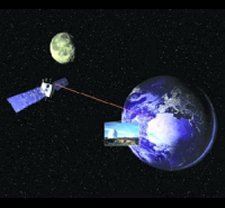
| - Support to the laser-link experiment (Figure 7) |
| - OBAN On Board Autonomous Navigation Experiment |
| - RSIS Radio Science Libration Experiment |
| Main Experiment features: |
| - 5.3° FOV, 1024 x 1024 Si-CCD |
| - Average pixel resolution of 80 m (30 m at perilune ) |
| - 5 colours: panchromatic + laser-link + 3 medium-band filters (0.75, 0.9, and 0.96 µm) |
| - 0.96 µm channel aligned to SIR |
| - High-density CCD electronics. & Micro-DPU |
| - Shielded Off The Shelf components. |
| - 1.8 kg (Opt.Head 400 g), 9W |
Table 5 SMART-1 AMIE multi-colour Camera
 |
 |
|
Fig 7. AMIE Laser link experiment |
Fig 8. (Image, courtesy Lunar and Planetary Institute |
The AMIE camera will take high-resolution images to study the illumination properties of the lunar south polar region during the 6 month lunar science phase. AMIE will be able to map the interior of dark craters, taking targeted exposures deeper than those from the Clementine instruments.
 |
|
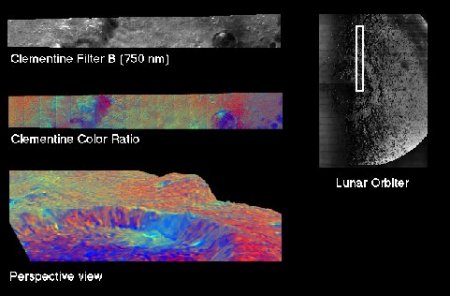
Fig. 9: Medium spatial resolution images (200 m/pixel) from Clementine UVVIS camera for the Orientale Basin (Courtesy of DLR-Berlin). The AMIE camera will provide the geological and spatial context for the other SMART-1 instruments, delivering high spatial resolution (30 m/pixel) multicolour images, as well as stereo imagery for topographic studies or multi-phase angle observations. |
 |
|
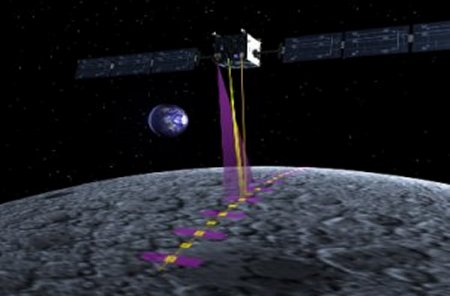
Fig. 10: Comparison between the swaths of the SMART-1 remote sensing instruments in lunar orbit: D-CIXS (32 x 12 deg), AMIE (5x5 deg or 2.5x1.25 deg colour frames) and SIR (4 arcmin point spectral continuous mapping) |
Operations, Data Archiving and Integration
The SMART-1 spacecraft will be operated from ESOC in Darmstadt. The Mission Operations Centre (MOC) will include the Main Control Room (MCR) augmented by a Flight Dynamics Room, Dedicated Control Rooms, and Project Support Rooms. During the Launch and Early Orbit Phase (LEOP) and during the Moon Capture Phase, the MCR will be used for SMART-1 mission control. During the routine operations phases, a Dedicated Control Room will be used.
The SMART-1 Science and Technology Coordination (STOC) is located at ESTEC. STOC interfaces to the MOC to which it provides inputs to the Flight Operation Plan for the payload commanding at spacecraft level, and the Experiment Science Master Plan.
The Experiment Operation Facilities are located at each Principle Investigator site. They are connected to the STOC and MOC via the network and operate remotely the experiments. The coordination of the scientific activities is carried within the Science and
Technology Working Team (STWT) chaired by the Project Scientist, and via the STOC. Experiment requests for operations, commands and data delivery are routed via the STOC in an agreed procedure.
SMART-1 data will be archived following the PDS Planetary Data Systems Standards. There will be an inter-calibration and integration of the SMART-1 data both between the instruments and with existing data from previous missions such as Clementine and Lunar Prospector. Data will be integrated in a planetary database under construction at ESA RSSD. The SMART-1 team has also cooperation with the upcoming Japanese Lunar-A and SELENE missions (Foing 2002).
Summary
SMART-1 represents Europe's first lunar mission and will provide some significant advances to many issues currently active in lunar science, such as our understanding of lunar origin and evolution. The mission also contributes a step in developing an international program of lunar exploration. The spacecraft will be ready for launch in spring 2003, as an Ariane 5 Auxiliary passenger to GTO, and a cruise phase of 15-18 months to the Moon.
Three remote sensing instruments, D-CIXS, SIR and AMIE, will be used during the mission's nominal six months in lunar orbit, and these will return data that will be relevant to a broad range of lunar studies. The mission will provide the first global X-ray map of the Moon, global high spectral resolution NIR spectrometry, high spatial resolution colour imaging of selected regions. With a perilune near the lunar south pole, the South Pole-Aitken Basin (SPA) is a prime target for studies using the SMART-1 suite of instruments. Combined, these will aid a large number of science studies, from bulk crustal composition and theories of lunar origin/evolution to the search for cold traps at the lunar poles and the mapping of potential lunar resources.
Acknowledgements
Thanks are extended to the Co-Investigators of the SMART-1 Science and Technology Working Team (STWT), to the members of the SMART-1 project and industrial teams that have prepared the spacecraft and various aspects of the mission.
References
Bussey, D.B. and P.D. Spudis, Illumination conditions at the lunar south pole, Geophysics Research Letters, 26, No. 9, pp. 1187-1190, 1999.
Clark, P.E. and I. Adler, Utilization of independent solar flux measurements to eliminate non-geochemical variation in X-ray fluorescence data, Proceedings Lunar Planetary Science Conference, 12b, pp. 727-749, 1978.
Dunkin, S.K., M. Grande, I. Casanova et al., Scientific rationale for the D-CIXS X-ray spectrometer on board ESA's SMART-1 mission to the Moon, Planetary & Space Science, 51, pp. 435-442, 2003.
Feldman, W., D.J. Lawrence, R.C. Elphic et al., Polar hydrogen deposits on the Moon, Journal of Geophysical Research, 105,E7, pp. 4175-4196, 2000.
Foing, B.H. et al., Status of SMART-1 Mission to the Moon, LPSC XXXI Abstract #1677 (CDROM), 2000.
Foing, B.H., D. Heather, M. Almeida and SMART-1 STWT, The Science Goals of SMART-1, Earth, Moon & Planets, 85-86, pp. 523-531, 2001.
Foing, B.H., Lunar Exploration, Planetary & Space Science, 50, 14-15, pp. v-vi, 2002.
Grande M., R. Browning, N. Waltham et al., Lunar elemental composition and investigations with D-CIXS X-ray Spectrometer on SMART-1, LPSC XXXI Abstract #1442 (CDROM), 2000.
Grande M. et al., The D-CIXS spectrometer and its capabilities for lunar science, Adv. Space Research, 30, No. 8, pp.1901-1907, 2002.
Grande M., R. Browning, N. Waltham et al., The D-CIXS X-ray mapping spectrometer on SMART-1, Planetary & Space Science, 51, pp. 427-433, 2003.
Heather, D.J., Geological Investigations of the Lunar Surface Using Clementine Multi-spectral Data, Ph.D. Thesis, University of London: London, 2000.
Heather, D.J. and S.K. Dunkin, The Integration of Lunar Datasets and the SMART-1 Mission, ESA SP-462, 93-96, 2000.
Heather, D.J. and S.K Dunkin, Crustal stratigraphy of the Al-Khwarizmi-King/Tsiolkovsky-Stark region of the lunar farside as seen by Clementine, Planetary & Space Science, 50, 14-15, 1311, 2002.
Huovelin, J., L. Alha, H. Andersson et al., Planetary & Space Science, 50, 14-15, 1345, 2002.
Josset, J.L. et al., The Advanced Moon Micro Imager Experiment (AMIE) on SMART-1: A miniaturized imaging system for the observation of planetary surfaces, Planetary & Space Science, submitted 2003.
Keller, H.U. et al., the SMART-1 Infrared Spectrometer (SIR): a compact technology for remote investigation of planetary mineralogy, Planetary & Space Science, submitted 2003.
Lawrence, D.J., W.C. Feldman, R.C. Elphic et al, Journal of Geophysical Research -Planets, E12, pp. 13-19, 2002.
Lucey P.G., G.J.Taylor, B.R. Hawke., FeO and TiO2 concentrations in the South Pole-Aitken basin: implications for mantle composition and basin formation, Journal of Geophysical Research , 103, pp.3701-3708, 1998.
Marini, A.E, G.D. Racca, B.H. Foing, SMART-1 Technology preparation to future planetary missions, Advances in Space Research, 30, No. 8, pp.1895-1900, 2002.
Muinonen, K., Y. Shkuratov, A. Ovcharenko et al, The SMART-1 AMIE experiment: implication to the lunar opposition effect, Planetary & Space Science, 50, 14-15, pp.1339-1344, 2002.
Nathues, A., U. Mall, H.U. Keller, Near IR Spectrometry with SIR on SMART-1, ESA SP-462, p.101, 2000.
Pieters C.M., S. Tompkins., G. He et al., Mineralogy of the mafic anomaly in the South Pole-Aitken basin (SPA): implications for the excavation of the lunar mantle, Geophysics Research Letters, 24, pp. 1903-1906, 1997.
Pieters, C.M. and S.Tompkins, Tsiolkovsky crater: A window into crustal processes on the lunar farside, Journal Geophysical Research , 104,.E9, pp.21935-21949, 1999.
Racca, G.D., A. Marini, L. Stagnaro et al., SMART-1 Mission Description and Development Status, Planetary & Space Science, 50, pp.1323-1337, 2002.
Racca, G.D., B.H.Foing, M. Coradini, SMART-1: the first time of Europe to the Moon, Earth Moon and Planets, 85-86, pp.379-395, 2001.
Shearer C.K. and J.J. Papike, Compositional dichotomy of the Mg-suite: Origin and implications for the thermal and compositional structure of the lunar mantle, LPSC, 31, 1405, 2000.
Tajmar, M., J. Gonzalez, G. Saccoccia et al, Plasma diagnostics and simulation for SMART-1, Planetary & Space Science, 50, 14-15, pp.1355-1360, 2002.
Tompkins, S. and Pieters, C.M., Mineralogy of the Lunar Crust: Results from Clementine, Meteoritics & Planetary Science, 34, pp.25-41, 1999.
Bernard.Foing esa.int, Manuscript submitted February 15, 2003; accepted March 3, 2003.