• → European Space Agency

    • About Science & Technology

    • For Public

    • For Educators

    • ESA

    • Science & Technology

    • SMART-1

    • Missions
    • Show All Missions
    • Mission Home
    • Summary
    • Fact Sheet
    • Objectives
    • Mission Team
    • Orbit View
    • Presentations
    • Background Science
    • Electric Spacecraft Propulsion
    • Moon
    • Spacecraft
    • 3D Model
    • Instruments
    • Mission Operations
    • Launch Vehicle
    • SMART-1 Launch Campaign
    • Launch Phase
    • Lunar Capture
    • Lunar Orbit
    • Lunar Impact
    • Status Reports
    • Mission Background
    • Science Operations
    • Data Archive
    • Resources
    • News Archive
    • Multimedia Gallery
    • Publication Archive
    • Calendar of Events
    • Services
    • Contact Us
    • Subscribe
    • Terms and Conditions
    • Bookmark and Share

    No. 20 - Eclipse Period Over

    22 Mar 2004 10:34

    The spacecraft has completed over 250 orbits, is in good status and with all functions performing nominally. The eclipse season is now over, with the last eclipse occurring on 21 March. The longest eclipse occurred on 13 March (lasted for 2 hours and 15 minutes) and stressed the power systems to their maximum limit. The spacecraft performed extremely well throughout this period and the power and the thermal control systems have been able to overcome this "long night" without a glitch.

    All the autonomous functions on board designed to monitor the eclipse phase and predict the power conditions have also been working very accurately. Now SMART-1 can re-start its journey to the Moon. The thrusting phase has restarted to increase further the orbit apogee. The new strategy involves thrusting around perigee at every revolution for about 8 to 10 hours for the next month. More details on this new strategy will be included in the next report.

    Orbital/Trajectory information

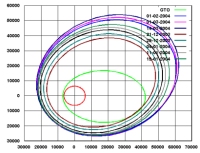
    The ESOC specialists periodically compute the osculating orbital elements. These elements define the so-called "osculating orbit" which would be travelled by the spacecraft if at that instant all perturbations, including EP thrust, would cease. Therefore, it is an image of the situation at that epoch. In reality, the path travelled by the spacecraft is a continuous spiral leading from one orbit to another. The most recent osculating elements are as follows:

    EPOCH (UTC) 2004/03/14 23:11:07.1

    Elements WRT Earth (J2000)
    Pericentre Distance (km)

    20 679.628282

    Apocentre Distance (km)

    68 788.909158

    Semi Major Axis (km)

    44 734.268720

    Eccentricity

    0.537723

    Inclination (deg)

    6.998998

    Asc. Node (deg)

    148.668864

    Arg. of Pericentre (deg)

    215.031401

    True Anomaly (deg)

    180.023840

    Osc. Orbital Period (h)

    26.155860

    Click for larger image
    Displayed in the plot are the osculating orbits at launch (GTO) and at different times throughout the mission. Since the start of the mission the electric propulsion engine has changed the orbital parameters as follows:

    • Semi-major axis of the orbit increased by more than 20 000 km
    • Perigee altitude from 656 km to 14 305 km
    • Apogee altitude from 35 844 km to 62 410 km
    • Orbital period from 10 hours 41 minutes to 26 hours and 10 minutes

    Contact Points

    Giuseppe Racca
    SMART-1 Project Manager
    ESA/ESTEC - SCI-PD
    Keplerlaan 1- 2200 AG Noordwijk, The Netherlands
    E-mail: Giuseppe.Raccaesa.int

    Bernard H. Foing
    SMART-1 Project Scientist
    ESA/ESTEC - SCI-SR
    Keplerlaan 1- 2200 AG Noordwijk, The Netherlands
    E-mail: Bernard.Foingesa.int


    Last Update: 08 Apr 2004

    • Shortcut URL
    • http://sci.esa.int/jump.cfm?oid=34880
    • Images and Videos
    • SMART-1 Osculating orbit up to 14.03.04
    • Status Reports
    • Archives
    • Documentation
    • PDF Archive

    Connect with us

    • RSS
    • Youtube
    • Twitter
    • Flickr
    • Google Buzz
    • Livestream
    • Subscribe
    • App Store
    • ESA Science Twitter

    Follow ESA science

    • Copyright 2000 - 2013 © European Space Agency. All rights reserved.

    • Terms and Conditions