
No. 31 - SMART-1 from Earth-bound to Moon-bound
This region is dynamically unstable. A small perturbation from an external force would be sufficient to destabilise the orbit and send the spacecraft into a chaotic trajectory resulting in a lunar impact, Earth impact or a heliocentric orbit.
The osculating orbital elements with respect to the Earth have little meaning now the spacecraft is in the transition region. The plot below, instead, shows the trajectory of SMART-1 (in red) together with that of the Moon (in green) for the period 2-20 November 2004.
|
|
|
SMART-1 and Moon orbit for the period 2-20 November 2004 |
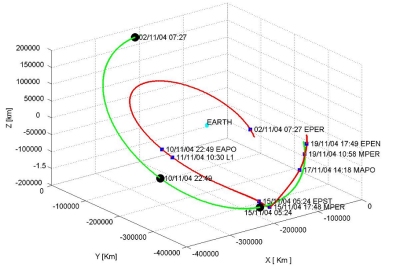
The spacecraft is currently proceeding unpowered and is planned to enter lunar orbit on 15 November, reaching the first perilune at 17:48 UTC. After capture has taken place, SMART-1 is expected to have a polar elliptical orbit around the Moon with the following osculating elements, as computed by the ESOC specialists.
|
EPOCH (UTC) 2004/11/15 17:47:12.1 Elements WRT Moon (J2000) |
|
| Pericentre Distance (km) |
6 700.720303 |
| Apocentre Distance (km) |
53 215.151264 |
| Semi Major Axis (km) |
29 957.935784 |
| Eccentricity |
0.776329 |
| Inclination (deg) |
81.084632 |
| Asc. Node (deg) |
246.527011 |
| Arg. of Pericentre (deg) |
308.016118 |
| True Anomaly (deg) |
0.000677 |
| Osc. Orbital Period (h) |
129.247777 |
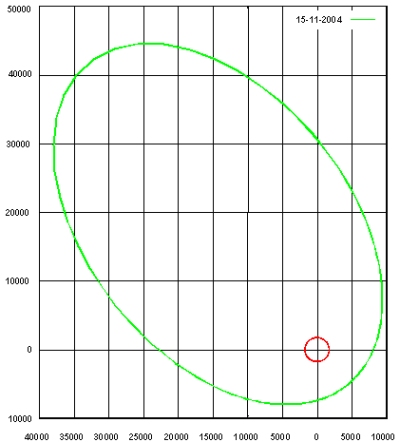
In this diagram the osculating orbit of the first lunar orbit is plotted.
- The perilune altitude is 4962 km
- The apolune altitude is 51 477 km
- The orbital period is 5 days, 9 hours and 14 minutes.
It should be noted that the orbit plane is not polar yet, as the inclination is only 81°. The pericentre is positioned close to the South pole at 52° South latitude
|
|
|
Expected first lunar orbit of SMART-1 after capture on 15.11.2004 |
Contact Points
Giuseppe Racca
SMART-1 Project Manager
ESA/ESTEC - SCI-PD
Keplerlaan 1- 2200 AG Noordwijk, The Netherlands
E-mail: Giuseppe.Racca esa.int
Bernard H. Foing
SMART-1 Project Scientist
ESA/ESTEC - SCI-SR
Keplerlaan 1- 2200 AG Noordwijk, The Netherlands
E-mail: Bernard.Foingesa.int
