
Titan Surface Landing
Descent Preparation and Communication
The Huygens mission officially started at around 09:06 UTC when the Huygens probe reached the predetermined interface altitude of 1270 km above the surface of Titan. Prior to this mark two crucial events took place that marked a transition from the cruise phase to operations phase:
- 04:44 UTC
Mission Timer Unit (MTU) activated the Huygens probe. - 07:02 UTC
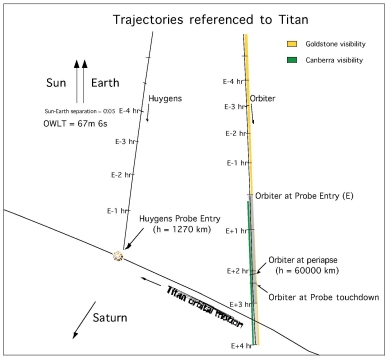
Cassini turned to point the HGA at the landing site in order to communicate with the probe. Communications would last for a maximum of 4h 36 minutes after interface at which point Huygens would pass over the horizon relative to Cassini.
 |
|
Trajectory of the Huygens Probe and the Cassini Orbiter from Entry |
Descent To Surface
The mission is thought to have followed the pre-mission schedule (listed in detail below) reasonably accurately. The only real variation is the surface descent phase took 2h27m50s as opposed to the pre-mission estimate of 2h21m.
It will be some time before scientists full assess the descent profile taken by Huygens - although there is lots of information to work with. Alongside the spacecraft instrument readings the descent of Huygens was tracked by radio telescopes around the world, which monitored the carrier signal sent by a transmitter activated when the first parachute deployed. The confirmation of the detection of this signal by the Green Bank 110m dish at around 10:30 UTC was the first indication that the mission had gone to plan.
From interface altitude at 1270 km the probe desecened through haze until an altitude of about 30 km above the surface. This was around half the altitude suggested by pre-mission estimates of between 70 to 50 km above the surface.
At an altitude of 700m above the surface the descent lamp was activated. The purpose of this lamp was to not to illuminate the landing site, the light levels on the surface of Titan are roughly 1000 times less than sunlight and 1000 times stronger than a full moon, but to provide a monochromatic light source and enable scientists to accurately determine the reflectivity of the surface.
Surface Phase
The surface phase of the mission lasted 1h 10 minutes - considerably longer than had been anticipated. There were three main reasons for this:
- The initial mission scenario allowed Huygens and Cassini to communicate for around 2h15m, the revised scenario allowed for 4h36m
- There was no failure on the batteries so all five could be used to power the probe. System redundancy meant Huygens only required four batteries to complete a nominal mission
- The landing on the surface was soft meaning no damage was done to the probe.
Early indications are that the surface where Titan landed consists of a thin frozen crust that is around 10 cm thick with a less dense layer benath.
Timeline of Events
| Ground UTC | Time wrt Entry | Event |
| 6 January 2005 | ||
| 11:53 | Spacecraft configured for probe relay. All instruments except MAG are turned off | |
| 7 January 2005 | ||
| 09:00 | -07d 00h | Probe relay critical sequence begins. 8 day quiet period of minimal spacecraft activity before relay begins; Orbiter on thruster control |
| 14 January 2005 | ||
| 06:26 | Set Solid State Recorder pointers for probe recording | |
| 06:38 | - 02h 28m | Transition to thruster control for relay |
| 06:48 | - 02h 18m | Perform final recorder configuration for relay |
| 06:50 | - 02h 16m | Turn on probe receivers |
| 07:02 | - 02h 04m | Turn Orbiter to point to Titan |
| 07:14 | - 01h 52m | Turn to Titan complete |
| 07:17 | - 01h 49m | Disable X band downlink |
| 08:44 | - 00h 22m | Probe turns transmitters on; Low power mode |
| 09:06 | + 00h 00m | Probe reaches interface altitude. Entry altitude = 1270 km |
| 09:08 | + 00h 02m | Probe feels maximum deceleration |
| 09:09 | + 00h 03m | Pilot chute deployed at 170-190 km altitude Speed = Mach 1.5 Pilot chute is 2.6m in diameter |
| 09:09 | + 00h 03m | Aft cover released, main parachute deployed Altitude 160-180 km Speed = Mach 1.5 2.5 seconds after pilot chute deployed main chute is 8.3m in diameter |
| 09:10 | + 00h 04m | Probe begins transmission to Orbiter |
| 09:10 | + 00h 04m | Release front shield Transmitters to high power Istruments configured for descent Measurements begin 152-175 km Speed < Mach 0.6 |
| 09:25 | + 00h 19m | Main parachute separation Deploy stabilizing drogue chute 110-140 km altitude Drogue is 3m in diameter |
| 09:42 | + 00h 36m | Surface proximity sensor activated at 60 km altitude |
| 09:49 | + 00h 43m | Possible icing effects to Probe at 50 km altitude |
| 11:12 | + 02h 06m | Titan-C orbiter closest approach. Inbound 60 000 km flyby at 5.4 kms-1, 93 deg phase |
| 11:23 | + 02h 17m | Descent imager lamp on |
| 11:27 | + 02h 21m | Surface impact, end descent phase. May vary ± 15 min depending on descent time |
| 13:37 | + 04h 31m | Orbiter stops collecting probe data. Maximum of 4 hours and 36 minutes of data collection |
| 13:39 | + 04h 33m | Write protect probe data partitions. Partitions A5 and B5 of Solid State Recorder are protected from further data writing. |
| 13:47 | + 04h 41m | Turn Orbiter to point to Earth |
| 13:50 | + 04h 44m | Turn to Earth complete |
| 13:59 | + 04h 53m | Critical sequence ends; S07 background sequence B begins |
| 14:00 | + 04h 54m | Post-Probe tracking begins. Canberra 70m station receiving; 10 minutes for DSN lockup allocated |
| 14:07 | + 05h 01m | First telemetry data sent to Earth |
| 14:10 | + 05h 04m | Playback of probe data begins at Canberra at 66,360 bps |
| 16:50 | + 07h 44m | End playback of first partition First copy of probe data received at Earth |
| 16:57 | + 07h 51m | Ascending ring-plane crossing Distance = 18.4 Saturn radii |
| 17:53 | + 08h 47m | Start tracking at Madrid 70m. Data rate upgraded to 142,200 bps |
| 21:00 | + 11h 54m | End first full playback of all probe data. Complete set of all copies probe data received at Earth |
| 15 January 2005 | ||
| 00:22 | First complete set of probe data reaches Huygens Operations Center. No later than time listed; likely up to ~3 hours earlier | |
| 02:28 | + 17h 22m | Start tracking at Goldstone 70m |
| 11:00 | + 01d 02h | Power on of orbiter instruments, if Orbiter is healthy and playback proceeding per plan |
| 12:23 | + 01d 03h | End nominal playback of Probe data |
Pre-mission predicted times.