Planck first light yields promising results
17 September 2009
Preliminary results from the Planck First Light Survey, performed to demonstrate the stability of the instruments and the ability to calibrate them over long periods, indicate that the data quality is excellent. This bodes well for the full sky survey that has just begun.
|
|
|
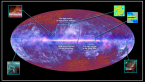
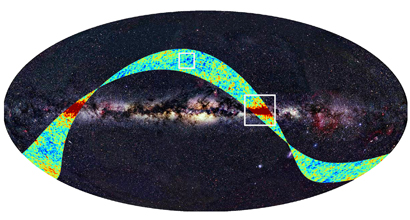
The false-colour strip superimposed on an optical map of the Milky Way indicates the region of the Planck First Light Survey. The two squares indicate regions for which detailed images are available - see below. (Click on the image for further details.) Credit: ESA, LFI & HFI Consortia (Planck), Background image: Axel Mellinger |
ESA's Planck microwave observatory - the first European mission designed to study the Cosmic Microwave Background, the relic radiation from the Big Bang - started regularly surveying the sky from its vantage point at L2 on 13 August 2009. Prior to this the two instruments of this modern day 'time machine' had been fine-tuned for optimum performance. Both instruments have demonstrated excellent characteristics so far, fulfilling expectations from ground tests. In preparation for routine scientific operations, their long-term stability has been verified by conducting a first 'trial' survey – the First Light Survey.
Planck's instruments provide key data for cosmology theories
Observing at microwave wavelengths, the satellite rotates around its axis, surveying the entire sky over time and in the process measuring tiny fluctuations in the temperature of the Cosmic Microwave Background (CMB).
Equipped with two powerful instruments, the Low Frequency Instrument (LFI) and the High Frequency Instrument (HFI), Planck will collect data continuously during a period of at least 15 months. The data will provide important constraints on theories that describe the infancy and evolution of the Universe.
Following launch on 14 May 2009, check-outs of the satellite's subsystems were started in parallel with the cool-down of the instruments' detectors. The detectors are looking for variations in the temperature of the CMB that are about a million times smaller than one degree – a feat comparable to measuring from Earth the body heat of a rabbit sitting on the Moon. To achieve this, Planck's detectors must be cooled to extremely low temperatures, some very close to absolute zero (–273.15°C, or 0 K).
With check-outs of the subsystems finished, instrument commissioning, optimisation, and initial calibration were completed by the second week of August.
First Light Survey complete
The First Light Survey, which began on 13 August 2009, covers a two-week period during which Planck surveyed the sky continuously. It was carried out to verify the stability of the instruments and the ability to calibrate them over long periods to the exquisite accuracy needed.
The First Light Survey was completed on 27 August, yielding maps of a strip of the sky, one for each of Planck’s nine frequencies. Each map is a ring about 15 degrees wide, stretching across the full sky. Preliminary analysis indicates that the quality of the data is excellent.
|
|
|
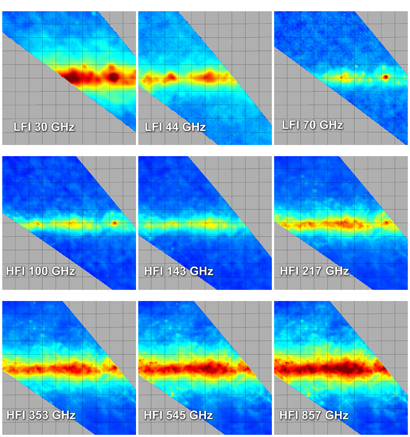
This mosaic of maps zooms in on a small part (20ox20o) of the First Light Survey, in which our own Milky Way shines very brightly. (Click on the image for further details.) Credit: ESA, LFI & HFI Consortia (Planck) |
|
| |
|
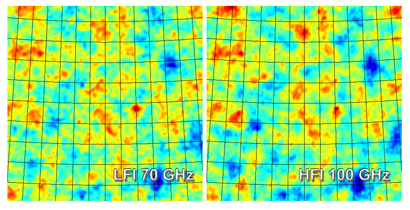
A zoom in on an approximately 10ox10o region of the First Light Survey where the Milky Way is not the predominant signal shows clearly the features which are of most interest to Planck, i.e. the Cosmic Microwave Background. (Click on the image for further details.) Credit: ESA, LFI & HFI Consortia (Planck) |
Routine operations are now underway
Routine operations started as soon as the First Light Survey was completed, and surveying will now continue for at least 15 months without a break. In approximately 6 months time, the first all-sky map will be assembled.
Within its allotted operational life of 15 months, Planck will be able to gather data for two full, independent all-sky maps. However, in order to fully exploit the high sensitivity of Planck, the data will require a great deal of delicate adjustments and careful analysis. About two years will be needed to fully process the data and to extract the main scientific results. The processed data will then be delivered to the worldwide community towards the end of 2012. It promises to contain a treasure trove of data that will keep both cosmologists and astrophysicists busy for decades to come.
Contacts
Jan Tauber, ESA Planck Project Scientist
Science and Robotic Exploration Directorate, ESA, The Netherlands
Email: jtauber rssd.esa.int
Phone: +31 71 5655342
Nazzareno Mandolesi, Principal Investigator, LFI
Istituto di Astrofisica Spaziale e Fisica Cosmica, Bologna, Italy
Email: mandolesiiasfbo.inaf.it
Phone: +39 3356507026
Jean-Loup Puget, Principal Investigator, HFI
Institut d’Astrophysique Spatiale, Orsay, France
Email: pugetias.u-psud.fr
Credits
Planck is a mission of the European Space Agency (ESA), which has managed the project since its inception in 1993 and funded the development of the satellite, its launch, and its operations.
ESA's prime industrial contractor for Planck was Thales Alenia Space (Cannes, France). Industry from all over Europe has contributed to the development of Planck. Especially notable contributions to the development are due to Thales Alenia Spazio (Torino, Italy) for the Service Module, Astrium (Friedrichshafen, Germany) for the Planck reflectors, and Oerlikon Space (Zürich, Switzerland) for the payload structures.
Much of the most challenging cryogenic and optical testing has been carried out at the Centre Spatial de Liège in Belgium and on the premises of Thales Alenia Space in Cannes.
Two large international Consortia, comprising a total of around 50 scientific institutes within Europe and North America, and funded by agencies from the participating countries, have each brought outstanding know-how to the development of the Low Frequency Instrument (LFI) and the High Frequency Instrument (HFI). Details can be found on the following web sites: http://www.satellite-planck.it/content/view/23/46/ (LFI) and http://www.planck.fr/heading1.html (HFI).
Important industrial contributions to the instrument development are due to Thales Alenia Space (Milano -Italy) for LFI, and Air Liquide - DTA (Grenoble, France) for HFI.
The Consortia are also responsible for scientific operations of their respective instruments and processing the acquired data. The Consortia are led by the Principal Investigators: J.-L. Puget of the Institut d’Astrophysique Spatiale in Orsay (France) leads HFI (funded principally by CNES and CNRS [INSU, IN2P3]), and N. Mandolesi of the Istituto di Astrofisica Spaziale e Fisica Cosmica in Bologna (Italy) leads LFI (funded principally by ASI and INAF).NASA has funded the US Planck Project, based at JPL and involving scientists at many US institutions, which has contributed very significantly to the efforts of these two Consortia.
A Consortium of Danish institutes (http://www.space.dtu.dk/English/Research/Projects/Planck.aspx), funded by the Danish National Research Council, has participated with ESA in a joint development of the two reflectors for the Planck telescope.
Planck is being operated by a Flight Control Team at the Mission Operations Centre (MOC) at ESA's European Space Operations Centre (ESOC), Darmstadt, Germany.
The Planck Science Office, located at ESA's European Space Astronomy Centre (ESAC), Spain, manages the survey and coordinates scientific operations of the two instruments.