
Cosmic Vision
Overview
Space science for Europe 2015–2025
Cosmic Vision 2015–2025 is the current cycle of ESA's long-term planning for space science missions. It is the latest in a series of mechanisms through which ESA's science missions are implemented and provides the stability needed for activities which typically take over two decades to go from initial concept to the production of scientific results.
Intended as an introduction to Cosmic Vision, this article explains the reasons for its existence, the way it works, the current status of its missions and the involvement of the scientific community.
As the missions that have been selected for Cosmic Vision 2015-2025 start to take shape, the science community is now turning its attention to the longer term, to what will come after Cosmic Vision 2015-2025.
The need for a long-term plan
Early in 2005, ESA's Huygens probe made its memorable descent through the atmosphere of one of Saturn's moons, Titan, and landed on the surface of the most distant body ever physically visited by a scientific probe. During the descent and for several hours after landing, Huygens returned a wealth of science data to Earth via its 'mother ship', the NASA planetary orbiter Cassini.
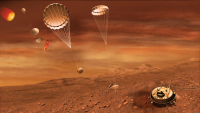 |
| Illustration depicting Huygens' landing on Titan. Credit: ESA |
Conceiving and executing the Huygens mission took more than 20 years, from the proposal in 1982 through approval in 1988, launch in 1997, and arrival in 2005. The success of this scientific and technological tour-de force was due to the interest and perseverance of the proposing scientists and to the highly creative and ingenious solutions worked out by industry to build a device that pushed the frontiers of space exploration to new limits. None of this – a development time of 17 years, preceded by a long preparatory effort – would have been possible if ESA had not had a long-term space science plan.
Continuation of a successful strategy
Scientists, technologists, national funding agencies, space industry and international partners all relied very heavily on the existence of ESA's long-term plan to build confidence in the success of a project that took two decades to develop. Huygens is by no means an exception in the length of development for a space science mission, which typically take decades to return their final science. The Horizon 2000 plan, which included the Cassini-Huygens and Rosetta missions, was prepared in 1984. Horizon 2000 Plus was drawn up in 1994-1995. Cosmic Vision 2015-2025, created in 2005, was the logical continuation into the next decade of the ESA science planning cycle. Horizon 2000 replaced the previous a la carte style of mission selection by an appetising table d’hôte. At its inception, there was judicious provision for updating the programme with missions still to be chosen. The promise of Horizon 2000 was fulfilled when the astronomy missions Herschel and Planck set off into space in 2009. The second step in this decadal series, Horizon 2000 Plus, includes the missions Gaia (launched in 2013), BepiColombo (launched in 2018) and the European contribution to the James Webb Space Telescope (scheduled for launch in 2021). The Cosmic Vision missions have been selected and are taking shape, with the first missions, CHEOPS and Solar Orbiter, launched in 2019 and 2020, respectively.
Selecting the themes for Cosmic Vision 2015-2025
Following the success of Horizon 2000 and Horizon 2000 Plus, Cosmic Vision 2015–2025 aims at furthering Europe's achievements in space science. The plan is based on a massive response by the scientific community to ESA's call for themes, issued in April 2004. A total of 151 novel ideas were submitted, more than twice as many as for the equivalent exercise in 1984.
 |
ESA's scientific advisory committees and working groups then made a preliminary selection of themes, which were discussed at a workshop in Paris, France, in September 2004, attended by nearly 400 members of the scientific community. After discussions with the Science Programme Committee (SPC) and its national delegations, ESA's Space Science Advisory Committee (SSAC) prepared the Cosmic Vision plan with the assistance of ESA's Directorate of Science. The SSAC is made up of scientists chosen for their scientific standing and who are expected to represent the views of the European science community as a whole rather than any particular national interest. A further encounter with the wider space science community occurred at a symposium in Noordwijk, the Netherlands, in April 2005. In May 2005, the SPC saw a draft of the plan and endorsed the approach.
Cosmic Vision 2015-2025 was designed to address four main questions that are high on the agenda of research across Europe (and, indeed, the world) concerning the Universe and our place in it:
- What are the conditions for planet formation and the emergence of life?
- How does the Solar System work?
- What are the fundamental physical laws of the Universe?
- How did the Universe originate and what is it made of?
(See Related Links and Related Publications for further details)
Call for proposals; missions selected
Cosmic Vision 2015-2025 is the current cycle of ESA's long-term plan for space science missions. The first Call for missions in this cycle was issued in March 2007. Since then, the programme has grown to include CHEOPS (CHaracterizing ExOPlanet Satellite), a small (S-class) mission launched in 2019; SMILE, a collaborative mission between ESA and the Chinese Academy of Sciences, scheduled for launch in the mid-2020s; Solar Orbiter (launched in 2020), Euclid, PLATO, Ariel, and EnVision, five medium (M-class) missions with launch slots in the 2020s and early 2030s; and JUICE (Jupiter Icy Moons Explorer), Athena (Advanced Telescope for High-ENergy Astrophysics), and LISA (Laser Interferometer Space Antenna), three large (L-class) missions for launch in the 2020s and 2030s. The Fast (F-class) missions, Comet Interceptor (selected in 2019) and ARRAKIHS (selected in 2022), are a new addition to the programme.
Building the programme
The missions in the current Cosmic Vision 2015-2025 portfolio were proposed by the European space science community responding to a regular series of open Calls for mission proposals, issued by ESA, to address the scientific themes established for Cosmic Vision 2015-2025 – see Table 1.
| Table 1: Building the science programme – missions in Cosmic Vision 2015-2025 | |||
| Date of Call | Mission class | Candidate missions | Selected mission(s) |
| March 2007 | Medium (M1) | Cross-Scale, Euclid, Marco Polo, PLATO, Solar Orbiter, SPICA | Solar Orbiter |
| Medium (M2) | Euclid | ||
| Large (L1) | IXO, Laplace (reformulated as JUICE), LISA | JUICE | |
| July 2010 | Medium (M3) | EChO, LOFT, MarcoPolo-R, PLATO, STE-QUEST | PLATO |
| March 2012 | Small (S1) | CHEOPS | CHEOPS |
| January 2014 | Large (L2) | Athena | Athena |
| August 2014 | Medium (M4) | Ariel, THOR, XIPE | Ariel |
| January 2015 | Mission in cooperation with CAS (1) | SMILE | SMILE |
| April 2016 | Medium (M5) | EnVision, SPICA, THESEUS | EnVision |
| October 2016 | Large (L3) | LISA | LISA |
| July 2018 | Fast (F) | Comet Interceptor | |
| December 2021 | Fast (F2) | ARRAKIHS | |
(1) ESA and the Chinese Academy of Sciences (CAS) issued a joint call for a mission
In addition to issuing Calls for mission proposals, ESA also invited the space science community to propose new science ideas for future space missions. In April 2017, from the proposals that had been submitted, ESA identified three themes for which the following studies were performed:
- Study of a platform for quantum physics experiments, with a focus on the boundaries of and relationship between quantum and classical physics, in particular investigating the aspect known as quantum decoherence.
- Study of small planetary platforms, which could enable new opportunities for scientific research to rocky planets, small bodies, or other destinations in the Solar System.
- Study to enlarge the achievements of Gaia with a near-infrared survey, with a focus on compiling a global, near-infrared view of the Milky Way.
Science community involvement
The European space science community is involved in every important step in Cosmic Vision. So far, they have taken part in the selection of the themes and proposed the candidate missions. They have assisted with the task of assessing the preliminary studies conducted by industry for M-class missions and to a similar activity for the L-class missions. Consortia of European institutes have carried out instrument studies for the M- and L-class candidate missions. Once the SPC selects the missions that will go forward for implementation, Europe's scientists will build many of the instruments that will fly on the spacecraft. During the operational life of the missions, they will be part of the team that plans mission activities and operates the instruments. The final step will be for them to deliver the science results to the world.