Impact of solar activity on GPS signal
 Date: 29 April 2009
Depicts: Plots of GPS signal strength
Location: Hawaii
Copyright: Image courtesy: P. Kintner -- Cornell University, USA
Show in archive: true
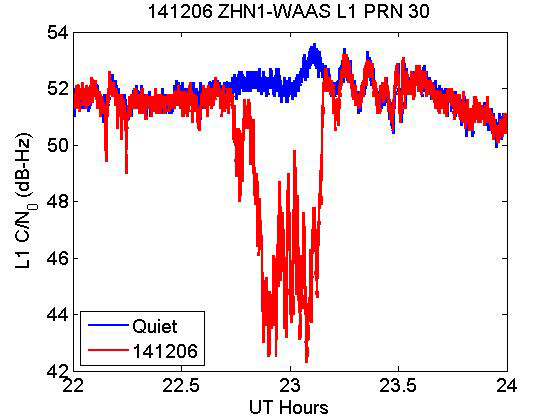
Impact of solar activity on the signal-to-noise ratio of GPS signal measured by a receiver located in Hawaii on 14 December 2006 (red) compared to what is normally received (blue). The cause was found to be intense radio emissions (called solar radio bursts) from the Sun. These are associated with solar flares.
Date: 29 April 2009
Depicts: Plots of GPS signal strength
Location: Hawaii
Copyright: Image courtesy: P. Kintner -- Cornell University, USA
Show in archive: true
Impact of solar activity on the signal-to-noise ratio of GPS signal measured by a receiver located in Hawaii on 14 December 2006 (red) compared to what is normally received (blue). The cause was found to be intense radio emissions (called solar radio bursts) from the Sun. These are associated with solar flares.
Last Update: 1 September 2019