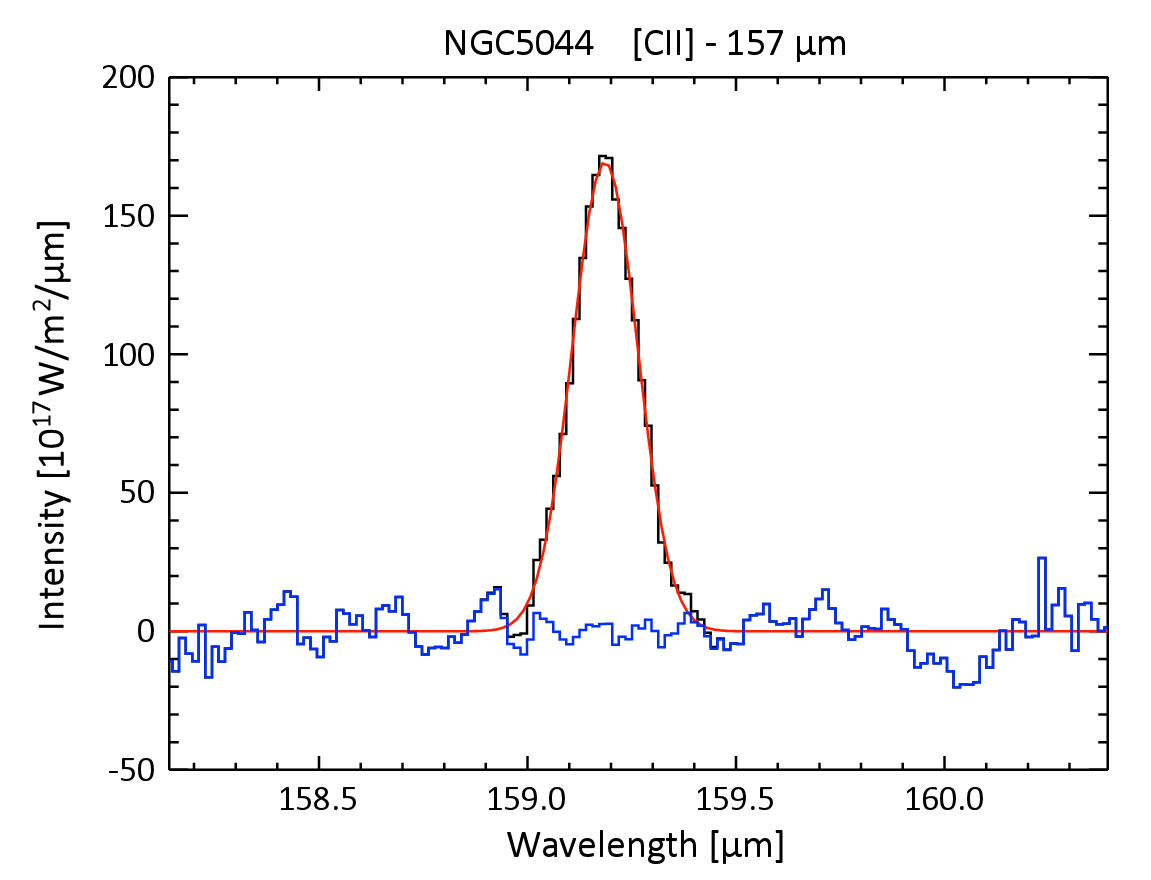
Herschel spectrum of the elliptical galaxy NGC 5044

Date: 24 February 2014
Satellite: Herschel
Copyright: ESA/Herschel/PACS. Acknowledgments: Norbert Werner, Stanford University, CA, USA
This graph shows a spectrum of the giant elliptical galaxy NGC 5044 taken with ESA's Herschel Space Observatory at far-infrared wavelengths.
The bright line at the centre is an emission line from ionised carbon at a rest wavelength of 157 microns. This reveals that the galaxy contains large amounts of cold gas.
This spectrum is part of a study of giant elliptical galaxies to figure out why galaxies of this type do not form stars. The data collected with Herschel showed that, contrary to previous belief, NGC 5044 contains plenty of cold gas – the raw material to form stars. The same holds true for most of the giant elliptical galaxies that they observed.
A multi-wavelength study suggests that, while hot gas cools down in these galaxies, stars do not form because of feedback from the central supermassive black hole, which heats up the gas again or pushes it beyond the galaxy's reach.
In the case of NGC 5044, the activity of the black hole has likely put an end to its star formation, but has not yet succeeded in clearing it of all its cold gas.