Gamma-ray burst after gravitational waves

Date: 16 October 2017
Satellite: INTEGRAL
Copyright: ESA/INTEGRAL/SPI/ISDC
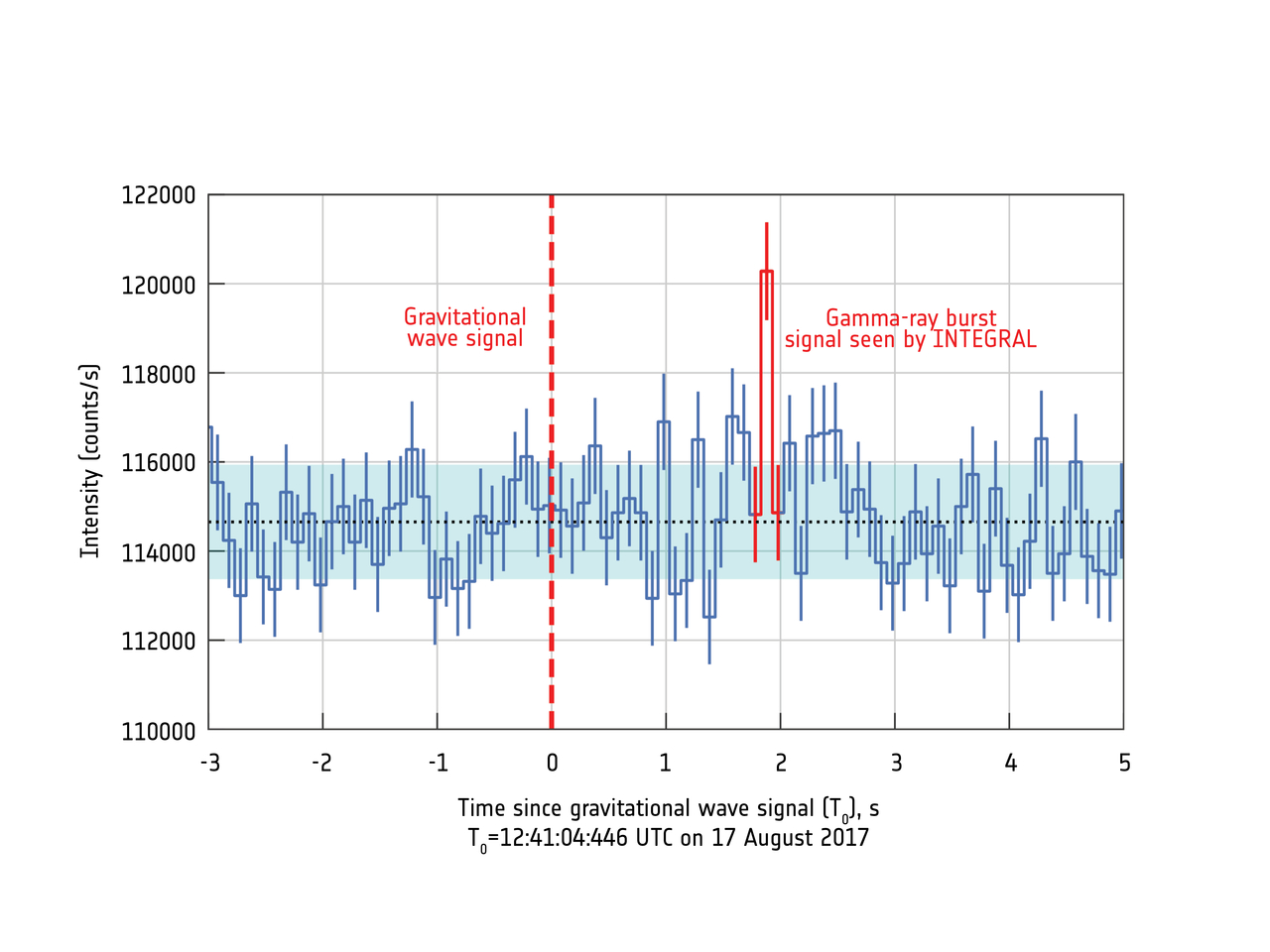
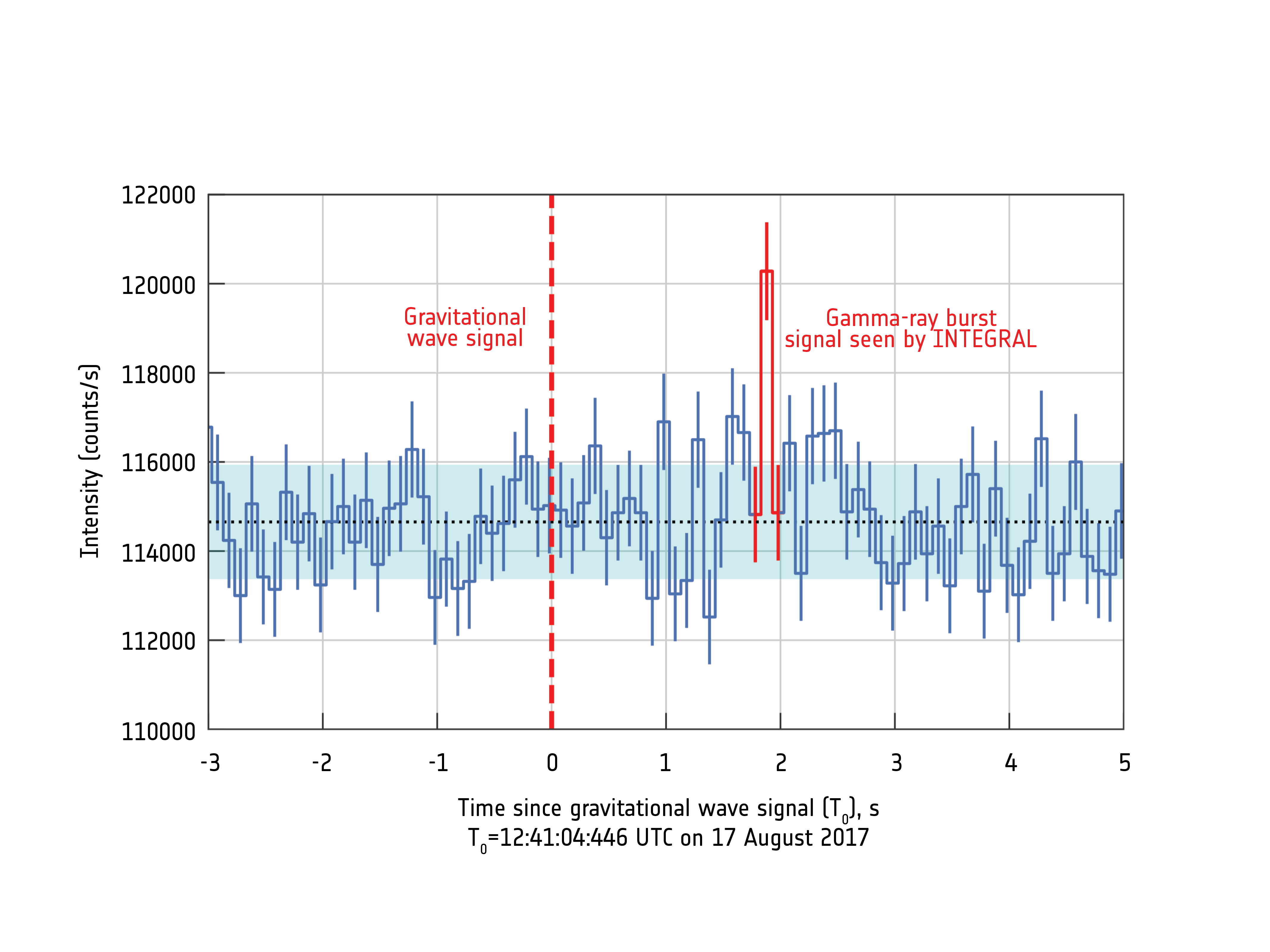
The intensity of gamma rays measured by ESA's INTEGRAL satellite on 17 August 2017.
Less than two seconds after the Laser Interferometer Gravitational-wave Observatory (LIGO) experiment was triggered by the passage of gravitational waves, marked as T0, the Anti-Coincidence Shield on INTEGRAL's SPI spectrometer, recorded a burst of gamma rays for 0.1 sec. The flash was also detected for almost two seconds by NASA's Fermi satellite.
The observations indicated that the gravitational waves and the gamma-ray burst originate from the same cosmic event: the collision of two neutron stars. This is the first discovery of gravitational waves and light coming from the same source.
Full story: INTEGRAL sees blast travelling with gravitational waves
Last Update: 1 September 2019