
Rosetta's target: comet 67P/Churyumov-Gerasimenko
| Rosetta's twelve-year journey in space. Credit: ESA. (Click here for further details and larger versions of this video.) |
Of particular interest were comets that had been observed over at least several orbits of the Sun, and which were known to be fairly active. Ideally, they had to follow orbital paths near the ecliptic plane, so that a rendezvous, prolonged survey and landing would be easier to achieve. Furthermore, the comet's flight into the inner Solar System had to coincide with the mission timeline of Rosetta, so that they both arrived in the right place at the right time for the historic rendezvous.
The favoured target for Rosetta was the periodic comet 46P/Wirtanen, but, after the launch was delayed, another regular visitor to the inner Solar System, 67P/Churyumov-Gerasimenko, was selected as a suitable replacement.
Like all comets, Churyumov-Gerasimenko is named after its discoverers. It was first observed in 1969, when several astronomers from Kiev visited the Alma-Ata Astrophysical Institute in Kazakhstan to conduct a survey of comets.
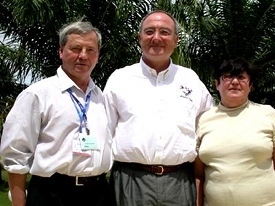 |
| Astronomer Klim Churyumov, ESA Director General Jean-Jacques Dordain and astronomer Svetlana Gerasimenko, pictured in 2004. Credit: Christian Sotty |
On 20 September, Klim Churyumov was examining a photograph of comet 32P/Comas Solá, taken by Svetlana Gerasimenko, when he noticed another comet-like object. After returning to Kiev, he studied the plate very carefully and eventually realised that they had indeed discovered a new comet.
Comet 67P is one of numerous short period comets which have orbital periods of less than 20 years and a low orbital inclination. Since their orbits are controlled by Jupiter's gravity, they are also called Jupiter Family comets.
These comets are believed to originate from the Kuiper Belt, a large reservoir of small icy bodies located just beyond Neptune. As a result of collisions or gravitational perturbations, some of these icy objects are ejected from the Kuiper Belt and fall towards the Sun.
When they cross the orbit of Jupiter, the comets gravitationally interact with the massive planet. Their orbits gradually change as a result of these interactions until they are eventually thrown out of the Solar System or collide with a planet or the Sun.
Churyumov-Gerasimenko reflects the steplike process of how encounters with Jupiter push a comet further into the inner Solar System. Analysis of its orbital evolution shows that, up to 1840, its perihelion distance – closest approach to the Sun - was 4.0 AU (four Sun-Earth distances or about 600 million km). This was too far from the Sun's heat for the ice-rich nucleus to vaporise and for tails to develop. This meant that the dormant comet was unobservable from Earth.
That year, a fairly close encounter with Jupiter caused the orbit to move inwards to a perihelion distance of 3.0 AU (450 million km). Over the next century, the perihelion gradually decreased further to 2.77 AU. Then, in 1959, another Jupiter encounter reduced the comet's perihelion to just 1.29 AU – which has changed little ever since. It currently completes one orbit of the Sun every 6.45 years.
The comet has now been observed from Earth on eight approaches to the Sun - 1969 (discovery), 1976, 1982, 1989, 1996, 2002, 2009 and 2015. Like all comets, it has a fairly small, solid nucleus which is thought to resemble a dirty snowball.
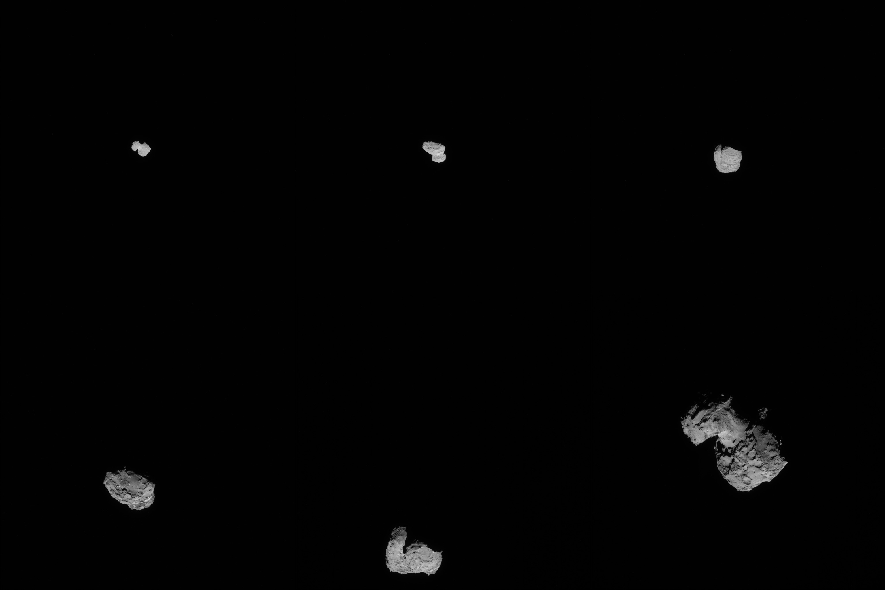 |
| Sequence of Rosetta navigation camera images taken between 1 and 6 August 2014, during the approach to comet 67P. Credit: ESA/Rosetta/NAVCAM |
The density of the nucleus seems to be much lower than that of water, indicating a loosely packed or porous object. Like other comets, its nucleus is generally blacker than coal, indicating a surface layer or crust of carbon-rich organic material.
We still know very little about the surface properties of the nucleus, so the selection of a suitable landing site for the Philae probe will only be possible after the arrival of Rosetta in August 2014, followed by a detailed survey from close quarters.
When Rosetta arrives at the comet it will be at a distance of about three Astronomical Units (450 million km) from the Sun. As it moves towards the Sun, the ice in the nucleus begins to sublimate and the comet begins to eject increasing amounts of dust. Ejection of micron-sized grains starts at about 4.3 AU, but millimetre-sized grains are more likely to appear between 3.4 and 3.2 AU. This leads to the development of a coma (a diffuse cloud of dust and gas surrounding the solid nucleus) and subsequently a tail of dust that trails away from the Sun. Early observations of the comet showed some evidence for variable activity between April and June 2014, with the coma brightening rapidly and then dying down again over a period of about six weeks. Approaching from the sunward side of the comet's orbit, the spacecraft should encounter less dust, with a low probability of being disabled by a large impact.
During the 2002/2003 apparition, the tail was up to 10 arc minutes long as seen from Earth, with a bright central condensation in a faint extended coma. Seven months after perihelion the tail continued to be very well developed, although it subsequently faded rapidly.
As is the case with most comets, activity is not evenly distributed on the surface of the nucleus and the coma of 67P is fed by several dust jets - at least three prominent active areas were identified during the 2009 apparition. In general, a rapid increase in cometary activity could be a problem for Rosetta, so the mission team plans to move the spacecraft further from the nucleus as the level of activity increases beyond an acceptable level.
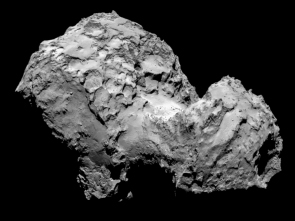 |
| Comet 67P by Rosetta's OSIRIS narrow-angle camera on 3 August 2014. Credit: ESA/Rosetta/MPS for OSIRIS Team MPS/UPD/LAM/IAA/SSO/INTA/UPM/DASP/IDA |
Even at its peak of activity about one month after perihelion, the comet is not very bright, with a typical visual magnitude of around 12, meaning that it will require a telescope to see it from Earth.
Comet 67P is classed as a dusty comet, with a dust to gas emission ratio of approximately 2:1. The peak dust production rate in 2002/03 was estimated at approximately 60 kg per second, although values as high as 220 kg per second were reported in 1982/83.
Sixty-one images of comet 67P/Churyumov-Gerasimenko were taken with the Wide Field Planetary Camera 2 on board the Hubble Space Telescope (HST) on 11-12 March 2003. The HST's sharp vision enabled astronomers to isolate the comet's nucleus from the coma. The images showed that the nucleus measures roughly five by three kilometres and has an approximately ellipsoidal (rugby ball) shape.
These results were independently confirmed by some of the largest ground-based telescopes, including the European Southern Observatory's Very Large Telescope, by observing the comet when it was inactive at large distance from the Sun.
Changes in its light curve appear to be closely linked with the effective radius of the nucleus as it rotates, rather than with variations in its surface albedo (brightness). These observations indicate that it spins once in approximately 12 hours.
Its axial inclination, orientation and direction of spin are still uncertain, although recent observations suggest that the axis is tilted about 40 degrees. This means that, as the comet approaches the Sun, its northern hemisphere is illuminated while part of the southern hemisphere is in darkness. During that period, no jets are visible.
The Sun is overhead at the comet's equator about 120 days before perihelion. If the comet behaves as in 2003 and 2009, the main jets should become visible a month before perihelion, i.e. mid-July 2015. This late onset of major activity will be good news for anyone concerned with the safety of Rosetta and its Philae lander.
|
Comet 67P/Churyumov-Gerasimenko |
|
| Size of nucleus: Overall dimensions Small lobe Large lobe |
4.34 km × 2.60 km × 2.12 km 2.50 km × 2.14 km × 1.64 km 4.10 km × 3.52 km × 1.63 km |
| Mass | 1.0 1013 kg |
| Volume | 18.7 km3 |
| Density | 533 kg/m3 |
| Rotation period | 12.40 hours (June 2014) 12.06 hours (September 2016) |
| Spin axis | Right ascension: 69 degrees Declination: 64 degrees |
| Orbital period | 6.45 years |
| Perihelion distance from Sun | 186 million km (1.243 AU) |
| Aphelion distance from Sun | 849.7 million km (5.68 AU) |
| Orbital eccentricity | 0.640 |
| Orbital inclination | 7.04 degrees |
| Water vapour production rate | 300 g/s (June 2014); 300 kg/s (August 2015); 300 g/s (August 2016) |
| Surface temperature | -93 °C to 53 °C |
| Subsurface temperature | -243 °C to -113 °C (August 2014) |
| Gases detected | Water, carbon monoxide, carbon dioxide, ammonia, methane, ethane, propane, butane, pentane, hexane, heptane, formic acid, acetic acid, acetaldehyde, ethylenglycol, propylenglycol, butanamide, methanol, ethanol, propanol, butanol, pentanol, glycine, argon, krypton, xenon, cyanogen, acetylene, hydrogen cyanide, acetonitril, formaldehyde, sodium, potassium, silicon, magnesium, hydrogensulphide, carbonylsulphide, sulphur monoxide, sulphur dioxide, carbon disulphide, nitrogen, oxygen, hydrogenperoxy, benzene, toluene, xylene, benzoic acid, naphthalene, hydrogen fluoride, hydrogen chloride, hydrogen bromide, phosphorus, chloromethane, methylamine, ethylamine, sulphur, disulphur, trisulphur, tetrasulfur, methanethiole (CH3SH), ethanethiol (C2H5SH), thioformaldehyde (CH2S) |
| Dust grains | A few hundred nanometres to a few millimetres |
| Year of discovery | 1969 |
| Discoverers | Klim Churyumov & Svetlana Gerasimenko |