
Summary
 |
|
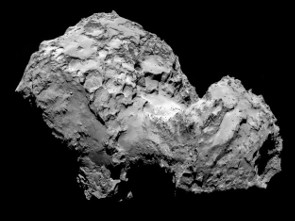
Comet 67P/Churyumov-Gerasimenko imaged by the OSIRIS narrow-angle camera on 3 August 2014. |
The mission was first considered in the late 1970s and developed from a sample-return plan to the plan for a lander. It was approved in November 1993 by ESA’s Science Programme Committee. The original mission target had been comet 46P/Wirtanen, but this was changed to 67P/Churyumov-Gerasimenko when it was clear that the launch would take place in 2004.
The spacecraft was launched from Kourou aboard an Ariane 5G+ on 2 March 2004. It required four gravity assists for its journey, one by Mars and three by Earth. Rosetta had already flown by the asteroids 2867 Steins (in 2008) and 21 Lutetia (in 2010), before entering deep space hibernation in June 2011.
Rosetta achieved a number of major milestones in 2014: Following a planned exit from hibernation on 20 January, all of the spacecraft's instruments were checked as it continued on its journey to 67P/Churyumov-Gerasimenko. The first science results were obtained even before the spacecraft arrived at the comet on 6 August 2014. On 12 November 2014, Rosetta's lander Philae was deployed to the surface. Operations continue throughout 2015, with many new scientific results being reported, as well as operational highlights such as the close flyby on 14 February.
Here are the key dates of the Rosetta mission:
| Event | Nominal date |
| Launch | 2 March 2004 |
| First Earth gravity assist | 4 March 2005 |
| Mars gravity assist | 25 February 2007 |
| Second Earth gravity assist | 13 November 2007 |
| Asteroid Steins flyby | 5 September 2008 |
| Third Earth gravity assist | 13 November 2009 |
| Asteroid Lutetia flyby | 10 July 2010 |
| Enter deep space hibernation | 8 June 2011 |
| Exit deep space hibernation | 20 January 2014 |
| Rendezvous manoeuvres begin | 7 May 2014 |
| Arrive at comet | 6 August 2014 |
| Start global mapping | 10 September 2014 |
| Lander delivery | 12 November 2014 |
| Perihelion passage | 13 August 2015 |
| End of mission | September 2016 |
| This animation tracks Rosetta's journey through the Solar System, using gravity slingshots from Earth and Mars to reach its final destination: comet 67P/Churyumov-Gerasimenko. Copyright: ESA. Click here for video details. |