
Lander Instruments
Introduction
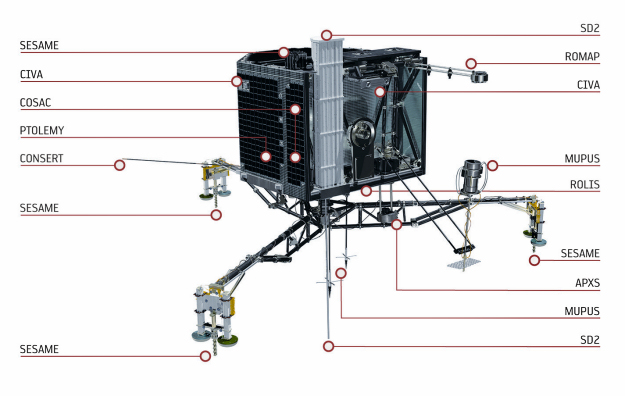 |
The ~100 kg Rosetta Lander will be the first spacecraft ever to make a soft landing on the surface of a comet nucleus. The Lander is provided by a European consortium under the leadership of the German Aerospace Research Institute (DLR). Other members of the consortium are ESA, CNES and institutes from Austria, Finland, France, Hungary, Ireland, Italy and the UK.
The box-shaped Lander is carried in piggyback fashion on the side of the Orbiter until it arrives at Comet 67P/Churyumov-Gerasimenko. Once the Orbiter is aligned correctly, the ground station commands the Lander to self-eject from the main spacecraft and unfold its three legs, ready for a gentle touch down at the end of the ballistic descent. On landing, the legs damp out most of the kinetic energy to reduce the chance of bouncing, and they can rotate, lift or tilt to return the Lander to an upright position.
Immediately after touchdown, a harpoon is fired to anchor the Lander to the ground and prevent it escaping from the comet's extremely weak gravity. The minimum mission target for scientific observations is one week, but surface operations may continue for many months.
Lander Design
The Lander structure consists of a baseplate, an instrument platform, and a polygonal sandwich construction, all made of carbon fibre. Some of the instruments and subsystems are beneath a hood which is covered with solar cells. An antenna transmits data from the surface to Earth via the Orbiter.
The Lander Team
The Lander project managers are:
- Dr Stephan Ulamec - DLR, Köln Porz-Wahn, Germany
- Dr Philippe Gaudon - CNES, Toulouse, France
- Dr Sylvie Espinasse - Italian Space Agency, Matera, Italy
Lead scientists for the Lander are:
- Dr Hermann Böhnhardt - Max-Planck-Institut für Sonnensystemforschung, Katlenburg-Lindau, Germany
- Dr. Jean-Pierre Bibring - Institut d'Astrophysique Spatiale, Université Paris Sud, Orsay, France
Rosetta Lander Instruments
| INSTRUMENT | PURPOSE | PRINCIPAL INVESTIGATOR |
| APXS | Alpha-p-X-ray spectrometer | G. Klingelhöfer Johannes Gutenberg-Universität, Mainz, Germany |
| CIVA | Panoramic and microscopic imaging system | J-P. Bibring Institut d'Astrophysique Spatiale, Université Paris Sud, Orsay, France |
| CONSERT | Radio sounding, nucleus tomography | A. Herique Institut de Planétologie et d'Astrophysique de Grenoble, Grenoble, France |
| COSAC | Evolved gas analyser - elemental and molecular composition | F. Goesmann Max-Planck-Institut für Sonnensystemforschung, Katlenburg-Lindau, Germany |
| Ptolemy | Evolved gas analyser - isotopic composition | I. Wright Open University, Milton Keynes, UK |
| MUPUS | Measurements of surface and subsurface properties | T. Spohn Institut für Planetenforschung, Deutsches Zentrum für Luft- und Raumfahrt, Berlin, Germany |
| ROLIS | Imaging | S. Mottola Deutsches Zentrum für Luft- und Raumfahrt, Berlin, Germany |
| ROMAP | Magnetometer and plasma monitor | H-U. Auster Technische Universität, Braunschweig, Germany I. Apáthy KFKI, Budapest, Hungary |
| SD2 | Drilling and sample retrieval | A. Ercoli-Finzi Politecnico di Milano, Milan, Italy |
| SESAME/CASSE | Surface Electric Sounding and Acoustic Monitoring Experiment / Comet Acoustic Surface Sounding Experiment | M. Knapmeyer Deutsches Zentrum für Luft- und Raumfahrt, Institute of Planetary Research, Asteroids and Comets, Berlin, Germany (Also PI for the SESAME consortium) |
| SESAME/DIM | Surface Electric Sounding and Acoustic Monitoring Experiment / Dust Impact Monitor | Harald Krüger Max-Planck-Institut für Sonnensystemforschung, Göttingen, Germany |
| SESAME/PP | Surface Electric Sounding and Acoustic Monitoring Experiment / Permittivity Probe | Walter Schmidt Finnish Meteorological Institute, Helsinki, Finland |
Rosetta Lander Payload
The Lander experiments will study the composition and structure of Comet 67P/Churyumov-Gerasimenko's nucleus.
The instruments are designed to:
- Measure the elemental, molecular, mineralogical, and isotopic composition of the comet's surface and subsurface material
- Measure characteristics of the nucleus such as near-surface strength, density, texture, porosity, ice phases and thermal properties; texture measurements will include microscopic studies of individual grains
The Lander also carries a Sampling Drilling and Distribution device (SD2), which will drill more than 20 cm into the surface, collect samples and deposit them in different ovens or deliver them for microscope inspection.
APXS
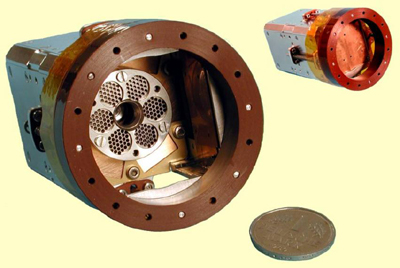
The goal of the Rosetta Alpha Proton X-ray Spectrometer (APXS) experiment is the determination of the chemical composition of the landing site and its potential alteration during the comet's approach to the Sun. The data obtained will be used to characterize the surface of the comet, to determine the chemical composition of the dust component, and to compare the dust with known meteorite types. These results will be brought into context with other measurements made on the lander and the orbiter to fully obtain a more complete picture of the present state of the comet, and to draw conclusions on its evolution and origin.
 |
|
APXS (with front side, open and closed), compared to the size of a 1 Deutsche Mark coin |
CIVA
Six identical micro-cameras take panoramic pictures of the surface. A spectrometer studies the composition, texture and albedo (reflectivity) of samples collected from the surface.
Rosetta Blog articles
| 13/11/2014 | Comet with a view |
| 13/11/2014 | Welcome to a comet! |
| 12/11/2014 | Farewell, Rosetta! |
CONSERT
CONSERT (COmet Nucleus Sounding Experiment by Radio-wave Transmission) is a complex experiment that will reveal the internal structure of a comet nucleus for the very first time. Instrument components are found on both the orbiter and the lander, the idea being to establish a radio link that passes through the comet nucleus. The way in which the radio waves propagate through the nucleus will give scientists clues as to its structure and nature.
CONSERT will examine many properties of the comet nucleus, such as:
- Its mean electrical properties: this will allow scientists to broadly characterise the types of materials present
- The correlation length: this is a measure of the average size of the sub-structures or 'Cometesimals' that have collected together to form the nucleus
- The number and thickness of the various layers or interfaces present beneath the surface
- Its overall structural homogeneity: this will allow scientist to determine whether the nucleus is a single uniform body or if it is a mixed collection of smaller bodies, more akin to a rubble pile.
After analysis, the CONSERT data will allow scientists to build up a detailed structural view of the comet nucleus, which will in turn constrain scenarios on how it was formed. The origin of the comet is closely linked to the conditions in the Primitive Solar Nebulae some 4600 million years ago. CONSERT will therefore play a vital role in fullfilling Rosetta's objective to further our understanding of the origin and formation of the Solar System.
Rosetta Blog articles
| 21/11/2014 | Homing in on Philae's final landing site |
COSAC
The COmetary SAmpling and Composition experiment COSAC is one of the two 'evolved gas analysers' (EGAs) on board the Rosetta-Lander. Whereas the other EGA, Ptolemy, aims mainly at accurately measuring isotopic ratios of light elements, the COSAC is specialised on detection and identification of complex organic molecules.
It is, like all Lander experiments, an ambitious undertaking, and could be described as an effort to analyse in situ, mainly with respect to the composition of the volatile fraction, cometary matter nearly as well and accurately as could be done in a laboratory on Earth or, in other words, it can be regarded as an attempt to bring a laboratory to the surface of the nucleus and make it work there, in part automatically, in part under remote control. Considering that the 'laboratory' equipment must be extremely low in mass, power consumption, and cost but high in efficiency, resolution, sensitivity, and reliability, that it will be used first more than 10 years after assembly, and that the working environment on the nucleus will be rather harsh, the COSAC enterprise is even more challenging.
The fact that this experiment can, due to the Rosetta Lander rotatability, conduct analyses and investigations at different spots of the landing site and, aided by the drill, take samples for analysis from a depth up to at least 0.2 m, adds possibilities which would not even have existed for the cometary sample return mission originally considered.
Rosetta Blog articles
| 19/11/2014 | Did Philae drill the comet? |
MUPUS
| MUPUS penetrator (PEN and hammer) |
The scientific objectives of MUPUS (MUlti-PUrpose Sensors for Surface and Sub-Surface Science) are summarised as follows:
- To understand the properties and layering of the near-surface matter as these evolve with time as the comet rotates and approaches the Sun.
- To understand the energy balance at the surface and its variation with time and depth.
- To understand the mass balance at the surface and its evolution with time.
- To provide ground truth for thermal mapping from the Orbiter, and to support other instruments on the Rosetta Lander (e.g. SESAME-CASSE).
Rosetta Blog articles
| 12/11/2015 | The sound of Philae conducting science |
| 18/11/2014 | Philae settles in dust-covered ice |
Ptolemy
Ptolemy is the first example of a new concept in space instrumentation, which has been devised to tackle the analytical challenge of making in situ isotopic measurements of solar system bodies. The instrument concept is termed 'MODULUS' which is taken to mean Methods Of Determining and Understanding Light elements from Unequivocal Stable isotope compositions.
MODULUS was named in honour of Thomas Young, the initial translator of the Rosetta stone, whose name is immortalised by the measure of elasticity known as Young's Modulus.
The scientific goal of the MODULUS concept is to understand the geochemistry of light elements, such as hydrogen, carbon, nitrogen and oxygen, by determining their nature, distribution and stable isotopic compositions.
The size of a small shoe box and weighing less than 5 kg, Ptolemy will use gas chromatography / mass spectrometry (GCMS) techniques to investigate the comet surface & subsurface.
Scientific Objectives
The scientific objectives of the Ptolemy instrument are:
- Evaluate the link between water ice on a comet and major bodies of water on Earth
- Comprehend the internal balance of volatiles on a comet and describe the cosmochemical fundamentals of cometary formation
- Elucidate the nature of organic components present on a comet and assess the relationship with equivalent materials known from other Solar System reservoirs (the Earth, asteroids, planets and their satellites, interplanetary dust etc.)
- Determine the nature of low temperature mineral components present on a comet and decipher the formation history of such materials
- Document certain features of any high-temperature, refractory, minerals
- Assess the relevance of comets to the operation of widespread and important Solar System processes such as planet formation and the origin of life
Instrument Description
Ptolemy is supplied with samples of cometary material by the SD2 sampling and drilling system. Once the lander is on the surface of the comet, SD2 will be used to obtain small cores of ice/dust from both the near-surface environment and at sub-surface depths of up to 200 mm. Solid samples collected in this way will be delivered to one of four ovens dedicated to Ptolemy, which are mounted on a circular, rotatable carousel. The carousel has a total of 32 ovens, with the remainder being used by COSAC and ÇIVA. Of the four Ptolemy ovens, three are for solid samples collected and delivered by SD2 whilst the fourth contains a gas-trapping substrate, which will be used to collect volatiles from the near-surface cometary atmosphere.
With an appropriate sample loaded into one of the ovens, the carousel rotates to a position whereby a device referred to as a "tapping station" is used to connect the oven to the inlet of the gas management system. At this point, sample volatiles can be released into the analytical system by heating the oven. Once in the analytical system, they are quantified, purified and chemically reacted (where necessary) to produce a relatively simple gas mixture. The gases are then passed to the ion trap mass spectrometer, either directly or through one of three analytical channels comprising gas chromatography columns and additional chemical processing reactors. For experiments requiring gas chromatography, a constant supply of helium carrier gas is delivered by a regulator, which ensures maintenance of the necessary pressure and flow rate. The helium is used to force the cometary gas mixture through the selected column and associated reactors in order to effect further separation, reaction and purification.
In either mode of operation, direct or via the analytic channels, the ion trap mass spectrometer is set to perform continuous sweeps over the mass range of interest , which can be anywhere between
The ion trap has two main functions: to obtain qualitative analytical data by assessing what gases are present in any particular sample and to measure stable isotope ratios. With the ion trap in a qualitative analytical mode the instrument operates over a large mass range (for example,
Rosetta Blog articles
| 02/12/2014 | The quest for organic molecules on the surface of 67P/C-G |
| 19/11/2014 | Did Philae drill the comet? |
ROLIS
The Descent & Down-Looking ROLIS Camera (Rosetta Lander Imaging System) will deliver first close-ups of the environment of the landing place of comet 67P/Churyumov-Gerasimenko during the descent.
After landing ROLIS will make high-resolved investigations to study the structure (morphology) and mineralogy of the surface.
Rosetta Blog articles
| 15/09/2015 | Philae's descent: The director's cut |
| 21/11/2014 | Approaching a comet in 3D |
| 13/11/2014 | 40 metres above a comet |
| 12/11/2014 | Here comes the lander! |
ROMAP
The Rosetta Lander Magnetometer and Plasma Monitor (ROMAP) is a multi-sensor experiment. The magnetic field is measured with a fluxgate magnetometer. An electrostatic analyzer with integrated Faraday cup measures ions and electrons. The local pressure is measured with Pirani and Penning sensors. The sensors are situated on a short boom. The deployment on the surface of a cometary nucleus demanded the development of a special digital magnetometer of little weight and small power requirements. For the first time a magnetic sensor will be operated from within a plasma sensor. A prototype of the magnetometer, named SPRUTMAG, was flown on space station MIR.
|
The ROMAP experiment is developed under the leadership of the TU Braunschweig |
Rosetta Blog articles
| 14/04/2015 | Rosetta and Philae find comet not magnetised |
| 28/11/2014 | Did Philae graze a crater rim during its first bounce? |
SD2
The sampling, drilling and distribution (SD2) subsystem will provide microscopes and advanced gas analysers with samples collected at different depths below the surface of the comet. Specifically SD2 can bore up to 250 mm into the surface of the comet and collect samples of material at predetermined and/or known depths. It then transports each sample to a carousel which feeds samples to different instrument stations: a spectrometer, a volume check plug, ovens for high and medium temperatures and a cleaning station. SD2 will be accommodated on the flat ground-plate of the Rosetta, where it will be exposed to the cometary environment.
Rosetta Blog articles
| 19/11/2014 | Did Philae drill the comet? |
| 09/04/2014 | Introducing SD2: Philae's Sampling, Drilling and Distribution instrument |
SESAME
The SESAME (Surface Electric Sounding and Acoustic Monitoring Experiment) electronics board and the integration of the components are managed by the German Aerospace Center (DLR).
The results of SESAME will help in understanding how comets, have formed and thus, how the solar system, including the Earth, was born.
Rosetta Blog articles
| 12/11/2015 | The sound of Philae conducting science |
| 20/11/2014 | The sound of touchdown |