
No. 34 - SMART-1 Approaching Final Lunar Orbit
The nominal mission duration is six months from the end of January until the end of July 2005. Shortly after this time, due to perturbations caused by the Earth's gravity, the orbit will become unstable and the spacecraft would spiral down to the surface unless an orbit re-boost is performed. The Xenon fuel remaining, after the final orbit has been reached, is estimated by the Flight Control Team at ESOC based on three different methods:
- The first method is based on a predetermined correlation between the input power to the engine with the Xenon flow rate. The integration of this flow rate through the mission leads to a predicted remaining fuel at the start of the nominal mission of 10.8 kg
- The second method is based on a formula for the instantaneous mass flow rate correlating the Xenon pressure and the Thermothrottle current of the XFC. The integration of this flow rate leads to a predicted remaining fuel of 9.6 kg
- The last method, which is deemed more accurate for an almost empty tank is based on the perfect gas law correlating the tank gas pressure, volume and temperature. This method predicts residual in the range of 6.6 to 7.8 kg
Since there will be a residual amount of 1.8 kg of Xenon that will not be usable, the remaining fuel in the worst case scenario will be less than 5 kg at the start of the nominal mission (and also at the end, since during the nominal science operations there is no consumption of Xenon). A re-boost manoeuvre consumes about 4 kg of fuel, and efforts are underway to optimise it in order to obtain the longest possible duration with the minimum fuel consumption.
The EP operations are expected to resume on 18 January. They will last for about ten days until the final operational orbit is reached.
Science Update
AMIE
|
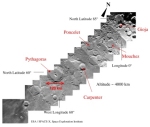
29 December 2004 Mosaic of successive Moon images taken by AMIE during the 1000-5000 km orbit on 29 December 2004 from an altitude of ~ 4000 km.
|
 |
|
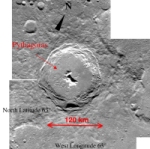
30 December 2004 This mosaic view of Pythagoras is composed of images taken by the AMIE camera during two successive orbits on 29 and 30 December 2004 from an altitude of ~ 4000 km. Pythagoras is a 120 km diameter complex lunar crater characterized by a relatively flat crater floor, a central peak and terraced walls. The terraced walls height reaches 5000 m. |
 |
Orbital/Trajectory Information
The following osculating orbital elements have been recently determined by a tracking campaign.
|
EPOCH (UTC) 2005/01/09 15:24:55.0 Elements WRT Moon and its equator of date |
|
| Pericentre Distance (km) |
2 751.510887 |
| Apocentre Distance (km) |
6 941.358753 |
| Semi Major Axis (km) |
4 846.434820 |
| Eccentricity |
0.432261 |
| Inclination (deg) |
87.892493 |
| Asc. Node (deg) |
236.866313 |
| Arg. of Pericentre (deg) |
288.717370 |
| True Anomaly (deg) |
179.999013 |
| Osc. Orbital Period (h) |
8.409861 |
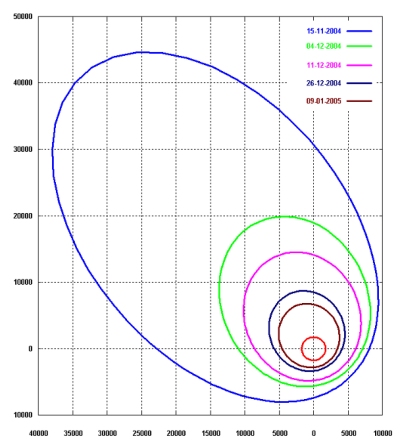
The diagram below shows the SMART-1 osculating orbit at several dates during the spiralling in to the final operational orbit. On 9 January the orbital period was slightly more than 8 hours and the orbital inclination reached 87.9°. The argument of perilune was at 289°, which means that the lowest altitude was in the Moon's southern hemisphere at about 72° latitude.
 |
|
SMART-1 osculating orbit up to 9 january 2005 |
Contact Points
Giuseppe Racca
SMART-1 Project Manager
ESA/ESTEC - SCI-PD
Keplerlaan 1- 2200 AG Noordwijk, The Netherlands
E-mail: Giuseppe.Racca esa.int
Bernard H. Foing
SMART-1 Project Scientist
ESA/ESTEC - SCI-SR
Keplerlaan 1- 2200 AG Noordwijk, The Netherlands
E-mail: Bernard.Foingesa.int
