
Cluster reveals the reformation of the Earth's bow shock
11 May 2007
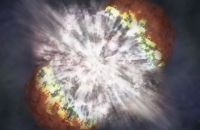
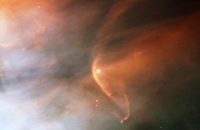
Plasma shock waves are some of the most spectacular, visually striking and energetic events in the Universe (Image 1). Generated by the explosion of stars (supernovae) or induced by stellar winds (Image 2), they can have a number of important effects.Supernova shock waves can indeed trigger the collapse of galactic nebulae and hence the formation of new stars and planetary systems. Such shocks can also accelerate particles to extraordinarily high energies.
 |
 |
| Image 1. Artist's illustration of the brightest supernova ever detected up today, SN 2006gy. Credit: NASA/CXC/M.Weiss |
Image 2. Bow shock around a star in Orion's Great Nebula. Credit: NASA and The Hubble Heritage Team (STScI/AURA) |
Stellar winds, supersonic flow of particles ejected by stars, create shock waves in front of other stars (Image 2) but also in front of their related planets, called bow shocks in this case. In the Solar system, the solar wind induces these bow shocks in front of each planet including Earth (Image 3), Jupiter and Saturn.
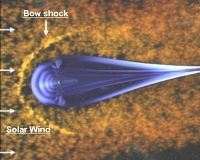 |
| Image 3. Earth's bow shock in the solar wind |
The Earth's bow shock is located at roughly one fourth the Earth-Moon distance (~90 000 km) but under certain conditions is far from being static and stationary in time, like many other shocks mentioned above. Dynamical behaviour of a shock is important as it is closely related to the way it interacts with particles, for example near the Earth by either rejecting ions of solar origin or on the contrary letting them through.
One critical parameter to describe the dynamics of a bow shock is the Alfvén Mach number, a quantity similar to the one used to characterize the supersonic speed of military jet fighters in aviation. Past theoretical studies and numerical simulations came to the conclusion that a critical Mach number exists, above which a bow shock cannot be stationary, but instead undergoes the process of reformation. This process can be described as a quasi-cyclic variation of the shock profile, very much like the formation, overturning and reformation of coastal water waves.
|
Animation 1. Propagation of a quasi-perpendicular shock. Simulation credit: B. Lembege and Ph. Savoini |
During the first stage of such a process, magnetic and electric fields accumulate at the front of the shock, attaining quite large magnitudes. In this region, the bulk of the incident plasma particles is slowed down and a majority is reflected back against the solar wind flow. Under the action of the incident solar wind and magnetic field, these reflected particles are accelerated and driven back towards and through the shock. At the same time, the magnetic and electric fields intensities are reduced and the process of field accumulation begins once more (Animation 1). However, no in-situ evidence of this model, called shock front reformation, was so far found in space, due to the use of only one of two spacecraft following each other, which does not enable to unambiguously discriminate between spatial and temporal variations.
Cluster Observations
On 24 January 2001, the four satellites of the ESA/NASA Cluster mission crossed the Earth's bow shock during four minutes, flying in tetrahedron formation with an inter-spacecraft distance of roughly 600 km. At this distance, simultaneous measurements of the magnetic field should agree fairly well if the bow shock were stationary. However, not only the magnetic field profiles but also the electric field fluctuations and the ion distributions were observed to differ considerably from one satellite to another, clearly showing that the shock is highly nonstationary. Detailed analysis of these data reveals that the observed variability of the shock front structure results from the reformation process.
"All the features derived from three different scientific experiments of the Cluster satellites provide the first convincing experimental evidence in favour of the shock front reformation model", wrote Dr. Lobzin, lead author of this study published 09 March 2007 in Geophysical Research Letters.
"Understanding the Physics of shocks is essential for apprehending both complex astrophysical phenomena and accurately forecast our nearby space environment. Once again the Cluster mission demonstrates the need of formation flying with multiple spacecraft to deepen our knowledge on shocks", says Philippe Escoubet, Cluster and Double Star project scientist at the European Space Agency.
V.V. Lobzin, V.V. Krasnoselskikh, J.-M. Bosqued, J.-L. Pinçon, S.J. Schwartz, and M. Dunlop (2007), Nonstationarity and reformation of high-Mach-number quasiperpendicular shocks: Cluster observations, Geophys. Res. Lett., 34, L05107, doi:10.1029/2006GL029095
Related articles
On theory and numerical simulations of shock front reformation:
Krasnoselskikh, V. V. (1985), The nonlinear motion of a plasma across a magnetic field, Sov. Phys. JETP, 62, 282
Quest, K. B. (1986), Simulations of high Mach number perpendicular shocks with resistive electrons, J. Geophys. Res., 91, 8805-8815
Galeev, A. A., V. V. Krasnoselskikh, and V. V. Lobzin (1988), Fine structure of the front of a quasi-perpendicular supercritical collisionless shock wave, Sov. J. Plasma Phys., 14, 697-702
Lembege, B., and P. Savoini (1992), Non-stationarity and stationarity of a 2-D quasiperpendicular supercritical collisionless shock by self-reformation, Phys. Fluids, 4(11), 3533-3548
Krasnoselskikh, V. V., B. Lembege, P. Savoini, and V. V. Lobzin (2002), Nonstationarity of strong collisionless quasiperpendicular shocks: theory and full particle numerical simulations, Phys. Plasmas, 9, 1192-1209 (see related publications in right-hand navigation)
Contact
Main authors
Vasili Lobzin and Vladimir Krasnoselskikh
LPCE/CNRS, 3A, Avenue de la Recherche Scientifique, 45071 Orleans CEDEX 2, France
Phone: +33 (0) 238255275
E-mails: vlobzine cnrs-orleans.fr, vkrasnoscnrs-orleans.fr
Web story author
Arnaud Masson, SCI-SO division, RSSD, ESA, The Netherlands
E-mail: Arnaud.Massonesa.int
Phone: +31-71-565-5634
Web story editors
Philippe Escoubet, SCI-SM division RSSD, ESA, The Netherlands
E-mail: Philippe.Escoubetesa.int
Phone: +31-71-565-4564
Arnaud Masson, SCI-SO division, RSSD, ESA, The Netherlands
E-mail: Arnaud.Massonesa.int
Phone: +31-71-565-5634
Matt Taylor, SCI-SO division, RSSD, ESA, The Netherlands
E-mail: Matthew.Tayloresa.int
Phone: +31-71-565-8009

