ESA Science & Technology - Rosetta
Fact Sheet
News
News

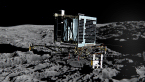
Philae's second touchdown site discovered at 'skull-top' ridge
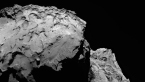
After years of detective work, the second touchdown site of Rosetta's Philae lander has been located on Comet 67P/Churyumov-Gerasimenko in a site that resembles the shape of a skull. Philae left its imprint in billions-of-years-old ice, revealing that the comet's icy interior is softer than cappuccino froth.

Unique ultraviolet aurora spied at Rosetta's comet
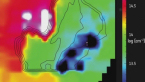
ESA's Rosetta mission has revealed a unique kind of aurora, an exciting phenomenon seen throughout the Solar System, at its target comet, Comet 67P/Churyumov-Gerasimenko.

Rosetta and the chameleon comet
A grand synthesis of Rosetta data has shown how its target comet repeatedly changed colour during the two years it was watched by the spacecraft. The chameleon comet's nucleus became progressively less red as it made its close pass around the Sun, and then red again as it returned to deep space.

Building blocks of life spotted on Rosetta's comet hint at composition of its birthplace
Observations from ESA's Rosetta spacecraft are shedding light on the mysterious make-up of Comet 67P/Churyumov-Gerasimenko, revealing a mix of compounds thought to be essential precursors to life – including salts of ammonium and a particular type of hydrocarbons.

Mapping the cosmic journey of phosphorus with Rosetta and ALMA
Astronomers using the combined powers of ESA's Rosetta mission and the ground-based Atacama Large Millimeter/submillimeter Array (ALMA) have traced the journey of phosphorus – one of life's building blocks – from star-forming regions to comets.

Comet's collapsing cliffs and bouncing boulders
Scientists analysing the treasure trove of images taken by ESA's Rosetta mission have turned up more evidence for curious bouncing boulders and dramatic cliff collapses.
Presentations
Presentations

Rosetta Science Highlights Briefing - Presentations
Latest Articles
Latest Articles

The surprising comet
Follow ESA's Mission To Comet 67P/C-G - The Rosetta Blog
Follow ESA's Mission To Comet 67P/C-G - The Rosetta Blog

Impressions of Rosetta's legacy: an e-book

OSIRIS Data Release: March–May 2015

Reflections

An encounter with Klim Churyumov

Last NAVCAM archive release

CometWatch - NavCam images
From Our Partners
From Our Partners

Rosetta Ground Based Campaign: Calling All Amateur Astronomers

ScienceCasts: How to Land on a Comet

Rosetta features in Von Karman Lecture Series

Rosetta-Alice spectrograph to begin first-ever close up ultraviolet studies of comet surface and atmosphere

NASA Instruments on Rosetta Start Comet Science